

Skip to content
  • Next Steps
    • What is Flowster?
    • Process Management vs Project Management
    • Why Flowster vs MS or Google Docs?
    • Flowster vs Flowcharts
    • Customer Stories
    • Browse our Template Marketplace
    • 3 Minute Demo
    • Visit our Blog
  • Products
    • Capture Chrome Extension
    • Flowster Unlimited
    • Flowster Connect: LinkedIn Automation
    • Flowster Agency Success Tactics (FAST) Playbook
    • Amazon Seller Playbook
  • Marketplace
  • Pricing
  • Next Steps
    • What is Flowster?
    • Process Management vs Project Management
    • Why Flowster vs MS or Google Docs?
    • Flowster vs Flowcharts
    • Customer Stories
    • Browse our Template Marketplace
    • 3 Minute Demo
    • Visit our Blog
  • Products
    • Capture Chrome Extension
    • Flowster Unlimited
    • Flowster Connect: LinkedIn Automation
    • Flowster Agency Success Tactics (FAST) Playbook
    • Amazon Seller Playbook
  • Marketplace
  • Pricing
Log In
Get started for free

AI-Powered Job Task Optimization: How to Future Proof Your Workplace

How to Future Proof Your Workplace with AI-Powered Job Task Optimization
Picture of Liz Dyrsmid

Liz Dyrsmid

  • Published: Apr 13, 2023
  • Last updated: Apr 14, 2023

In today’s fast-paced business world, companies are constantly looking for ways to improve productivity and efficiency. Job task optimization is an area that has made a lot of progress in recent years. 

This is the process of using technology to automate and streamline different tasks and processes. With the rise of artificial intelligence (AI), optimizing job tasks has taken on a new dimension. Companies can now use machine learning to improve workflows and boost productivity.

This article will explore the concept of AI-powered job task optimization in depth, looking at the benefits it can offer businesses and how it works. We will also talk about common questions and worries about using AI at work and examine what this technology might mean for the future of work.

Article Outline

What is AI-Powered Job Task Optimization?

For AI-powered job task optimization, machine learning algorithms are used to analyze data and automate different tasks and processes at work. This technology can be applied to a wide range of industries and job functions, from manufacturing and logistics to customer service and marketing.

The goal of AI-powered job task optimization is to improve workflows, cut down on mistakes, and boost productivity by automating tasks that are repetitive or take a lot of time. By doing so, businesses can free up their employees’ time to focus on higher-level tasks that require human expertise and creativity.

How Does AI-Powered Job Task Optimization Work?

The process of AI-powered job task optimization typically involves several steps:
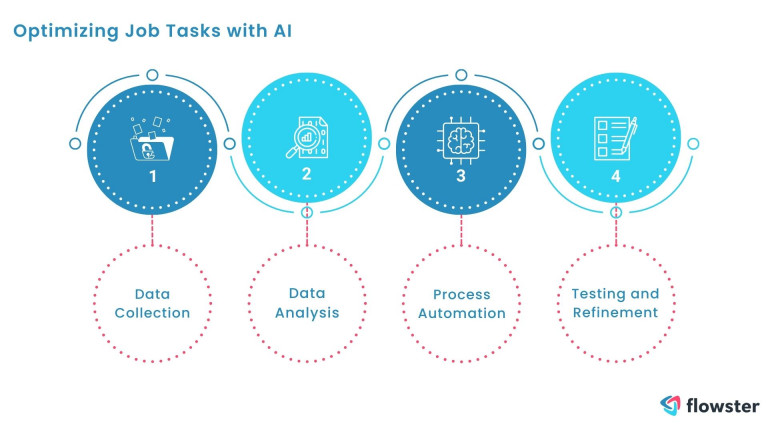
Steps to optimize job task using AI-powered automated workflows

Step 1: Data collection

The first step is to collect data on the specific task or process that needs to be optimized. This data may come from a variety of sources, such as sensors, databases, or manual input from employees.

Step 2: Data Analysis 

After the data has been collected, it is looked at with algorithms for machine learning to find patterns and new insights. This analysis can help find ways to improve the process, like cutting down on waste or getting rid of bottlenecks.

Step 3: Process Automation

After the analysis is complete, the next step is to automate the process using AI-powered tools and technologies. This could mean making custom software or using tools already on the market, like software for robotic process automation (RPA) or natural language processing (NLP).

Step 4: Testing and Refinement

Once the automated process is in place, it is tested and refined to ensure that it is working as intended. This may involve making adjustments to the algorithms or software to improve performance.

What Are the Benefits of AI-Powered Job Task Optimization?

The use of AI-powered job task optimization can offer several benefits for businesses, including:

Increased efficiency: By automating tasks that are repetitive or take a lot of time, businesses can be more efficient and finish some processes faster.

Reduced errors: Automation can also help reduce the likelihood of errors and mistakes, which can save businesses time and money in the long run.  

Improved productivity: With AI-powered job task optimization in place, employees can focus on higher-level tasks that require human expertise and creativity, which can lead to increased productivity and innovation.

Cost savings: Automation can help cut down on labor costs and make operations more efficient, which can save businesses a lot of money over time.

Scalability: AI-powered job task optimization can be easily scaled to accommodate growth or changes in business needs without requiring significant additional resources or labor. 

Transform Your Business Processes with Flowster's AI-Driven Automation

You can streamline your business process and complete more tasks with the sophisticated app Flowster, which uses AI technology. Experience the future of workflow management with Flowster's free 7-day trial. Start optimizing your business processes today!
Start 7-Day Free Trial

What Are Some Examples of AI-Powered Job Task Optimization?

AI-powered job task optimization can be applied to a wide range of industries and job functions. Some examples include:

Manufacturing: Machines with AI can do things like quality control, assembly, and packaging by themselves on the production line.

Logistics: AI-powered tools can improve shipping routes and delivery times, as well as automate tasks like keeping track of inventory and processing orders.

Customer service: Virtual assistants and chatbots can be used to automate customer service tasks like answering common questions and solving problems.

Marketing: AI-powered tools can help businesses analyze customer data and make personalized marketing campaigns based on each customer’s preferences and actions. 

Addressing Concerns About AI in the Workplace

Despite the potential benefits of AI-powered job task optimization, some people may have concerns about the use of AI in the workplace. Here are some common questions and concerns, along with answers and explanations:

Will AI replace human workers?

AI can automate some tasks and processes, but it probably won’t be able to do everything humans do. Instead, AI can be used to augment human capabilities and make certain tasks easier and more efficient. Also, as more businesses use technologies that are powered by AI, new jobs may open up in areas like data analysis and developing AI.

Is AI biased or discriminatory?

AI algorithms can be biased if they are trained on biased data or if the programmers who developed them hold biases themselves. But these biases can be lessened by doing things like using different kinds of training data and checking algorithms regularly to make sure they are fair.

What about privacy concerns?

AI-powered tools may collect and process personal data, which can raise privacy concerns. But businesses can ease these worries by putting in place strict policies about data privacy and making sure that data is collected and used in a clear and honest way.
AI powered job task optimization 1

The Future of Work with AI-Powered Job Task Optimization

As AI-powered job task optimization continues to evolve, it has the potential to transform the way we work and do business. By automating routine tasks and processes, businesses can give their employees more time to work on higher-level tasks that require human expertise and creativity.

However, as with any new technology, it is important to proceed with caution and ensure that AI is being used in a responsible and ethical manner. By doing this, businesses can use AI to drive innovation, boost productivity, and make the workplace more effective and efficient.

AI-Powered Job Task Optimization FAQs 

What is AI-powered job task optimization?

AI-powered job task optimization is when a business or organization uses artificial intelligence to automate and streamline different tasks and processes.

What are the benefits of AI-powered job task optimization?

AI-powered job task optimization has many benefits, such as increased efficiency, fewer mistakes, cost savings, the ability to grow, and the ability to give valuable insights into how customers behave and how the market is changing.

What are some examples of AI-powered job task optimization?

Examples of AI-powered job task optimization include manufacturing, logistics, customer service, and marketing.

Will AI replace human workers?

AI can automate some tasks and processes, but it probably won’t be able to do everything humans do. Instead, AI can be used to augment human capabilities and make certain tasks easier and more efficient.

What about privacy concerns with AI-powered technologies?

AI-powered tools may collect and process personal data, which can raise privacy concerns. But businesses can ease these worries by putting in place strict policies about data privacy and making sure that data is collected and used in a clear and honest way.

Conclusion

AI-powered job task optimization is a powerful tool that can help businesses automate and streamline different tasks and processes. By doing so, businesses can increase efficiency, reduce errors, and free up their employees’ time to focus on higher-level tasks.

While there may be concerns about the use of AI in the workplace, steps can be taken to mitigate these concerns and ensure that AI is being used in a responsible and ethical manner. As AI-powered job task optimization continues to evolve, it has the potential to transform the way we work and do business.

AI-powered technologies are likely to be used more in the future of work, and businesses that follow this trend are more likely to be able to compete and do well in the market.

AI-powered job task optimization can be applied across a wide range of industries and job functions, and its benefits are clear. By automating routine tasks, businesses can increase efficiency, reduce errors, and improve overall performance. 

In addition, AI-powered technologies can help businesses stay competitive by providing valuable insights into customer behavior, market trends, and more.

As AI-powered job task optimization becomes more common, businesses will need to invest in the right technology, talent, and training to fully use its potential. By doing so, businesses can create a more efficient and effective workplace while also providing new opportunities for their employees to learn and grow.

Ready to Create Your First AI-Driven Automated Workflow?

Start from scratch to make an automated workflow template, or look through our templates in Flowster’s Marketplace.

Want help? Use our “Done for You” service to let our experts build custom workflows for you.

Show Me Automated Workflow Templates

Related Articles

Would you like to learn more? See our other informative articles.

How Flowster’s New AI Feature is Supercharging Your Workflow Efficiency

What Process Management Tool Is Right For You? Flowster vs Alternatives

  •  Categories: Integrations, Productivity, Software
  •  Tags: business process, business processes, Productivity, SOPs, Standard Operating Procedure, Standard Operating Procedures, Workflow, Workflows

Leave a Reply Cancel reply

Your email address will not be published. Required fields are marked *

3827 S Carson St, 505-25 Unit #3040
Carson City, NV 89701, USA

© Copyright – Flowster, LLC

Linkedin Twitter Youtube Facebook Instagram
  • About
  • Careers
  • Blog
  • Contact Us
  • About
  • Careers
  • Blog
  • Contact Us
1% For The Planet

RESOURCES

  • Help Docs
  • Integrations
  • Affiliates
  • Virtual Assistant Placement Program
  • Training Videos
  • Partner Webinars
  • Content Partner Program

LEGAL

  • Privacy Policy
  • Terms of Service

Stay up to date on the latest from Flowster

We use cookies on our website to give you the most relevant experience by remembering your preferences and repeat visits. By clicking “Accept”, you consent to the use of ALL the cookies.
Do not sell my personal information.
Cookie settingsACCEPT
Manage consent

Privacy Overview

This website uses cookies to improve your experience while you navigate through the website. Out of these, the cookies that are categorized as necessary are stored on your browser as they are essential for the working of basic functionalities of the website. We also use third-party cookies that help us analyze and understand how you use this website. These cookies will be stored in your browser only with your consent. You also have the option to opt-out of these cookies. But opting out of some of these cookies may affect your browsing experience.
Necessary
Always Enabled
Necessary cookies are absolutely essential for the website to function properly. This category only includes cookies that ensures basic functionalities and security features of the website. These cookies do not store any personal information.
Functional
Functional cookies help to perform certain functionalities like sharing the content of the website on social media platforms, collect feedbacks, and other third-party features.
CookieDurationDescription
akavpau_ppsdsessionThis cookie is provided by Paypal. The cookie is used in context with transactions on the website.
nsidsessionThis cookie is set by the provider PayPal. This cookie is used to enable the PayPal payment service in the website.
tsrce3 daysThis cookie is set by the provider PayPal. This cookie is used to enable the PayPal payment service in the website.
x-pp-ssessionThis cookie is set by the provider PayPal. This cookie is used to process payments from the site.
Performance
Performance cookies are used to understand and analyze the key performance indexes of the website which helps in delivering a better user experience for the visitors.
CookieDurationDescription
ac_enable_tracking1 monthThis cookie is set by the Active Campaign. This cookie is used to keep track of the site usage.
YSCsessionThis cookies is set by Youtube and is used to track the views of embedded videos.
Analytics
Analytical cookies are used to understand how visitors interact with the website. These cookies help provide information on metrics the number of visitors, bounce rate, traffic source, etc.
CookieDurationDescription
_ga2 yearsThis cookie is installed by Google Analytics. The cookie is used to calculate visitor, session, campaign data and keep track of site usage for the site's analytics report. The cookies store information anonymously and assign a randomly generated number to identify unique visitors.
_gcl_au3 monthsThis cookie is used by Google Analytics to understand user interaction with the website.
_gid1 dayThis cookie is installed by Google Analytics. The cookie is used to store information of how visitors use a website and helps in creating an analytics report of how the website is doing. The data collected including the number visitors, the source where they have come from, and the pages visted in an anonymous form.
_hjFirstSeen30 minutesThis is set by Hotjar to identify a new user’s first session. It stores a true/false value, indicating whether this was the first time Hotjar saw this user. It is used by Recording filters to identify new user sessions.
_omappvp11 yearsThe cookie is set to identify new vs returning users. The cookie is used in conjunction with _omappvs cookie to determine whether a user is new or returning.
_omappvs20 minutesThe cookie is used to in conjunction with the _omappvp cookies. If the cookies are set, the user is a returning user. If neither of the cookies are set, the user is a new user.
_uetsid1 dayThis cookies are used to collect analytical information about how visitors use the website. This information is used to compile report and improve site.
Advertisement
Advertisement cookies are used to provide visitors with relevant ads and marketing campaigns. These cookies track visitors across websites and collect information to provide customized ads.
CookieDurationDescription
_fbp3 monthsThis cookie is set by Facebook to deliver advertisement when they are on Facebook or a digital platform powered by Facebook advertising after visiting this website.
fr3 monthsThe cookie is set by Facebook to show relevant advertisments to the users and measure and improve the advertisements. The cookie also tracks the behavior of the user across the web on sites that have Facebook pixel or Facebook social plugin.
IDE1 year 24 daysUsed by Google DoubleClick and stores information about how the user uses the website and any other advertisement before visiting the website. This is used to present users with ads that are relevant to them according to the user profile.
MUID1 year 24 daysUsed by Microsoft as a unique identifier. The cookie is set by embedded Microsoft scripts. The purpose of this cookie is to synchronize the ID across many different Microsoft domains to enable user tracking.
test_cookie15 minutesThis cookie is set by doubleclick.net. The purpose of the cookie is to determine if the user's browser supports cookies.
uidThis cookie is used to measure the number and behavior of the visitors to the website anonymously. The data includes the number of visits, average duration of the visit on the website, pages visited, etc. for the purpose of better understanding user preferences for targeted advertisments.
VISITOR_INFO1_LIVE5 months 27 daysThis cookie is set by Youtube. Used to track the information of the embedded YouTube videos on a website.
Others
Other uncategorized cookies are those that are being analyzed and have not been classified into a category as yet.
CookieDurationDescription
_fw_crm_v1 yearNo description
_gat_UA-124464104-11 minuteNo description
_gat_UA-182261587-11 minuteNo description
_hjAbsoluteSessionInProgress30 minutesNo description
_hjid1 yearThis cookie is set by Hotjar. This cookie is set when the customer first lands on a page with the Hotjar script. It is used to persist the random user ID, unique to that site on the browser. This ensures that behavior in subsequent visits to the same site will be attributed to the same user ID.
_hjIncludedInPageviewSample2 minutesNo description
_hjIncludedInSessionSample2 minutesNo description
_hjTLDTestsessionNo description
_lfa2 yearsThis cookie is set by the provider Leadfeeder. This cookie is used for identifying the IP address of devices visiting the website. The cookie collects information such as IP addresses, time spent on website and page requests for the visits.This collected information is used for retargeting of multiple users routing from the same IP address.
_seg_uid1 yearNo description
_seg_uid_35361 yearNo description
_seg_visitor_35361 yearNo description
_uetvid16 days 6 hoursNo description
CONSENT16 years 8 months 2 days 6 hoursNo description
cookielawinfo-checkbox-functional1 yearThe cookie is set by GDPR cookie consent to record the user consent for the cookies in the category "Functional".
cookielawinfo-checkbox-others1 yearNo description
DO-LBNo description
enforce_policy1 yearNo description
hyperise_session2 hoursNo description
l7_az30 minutesNo description
LANG9 hoursNo description
prism_7995608311 monthNo description
RUL1 yearNo description
whr_nov1 yearNo description
x-cdnNo description
SAVE & ACCEPT
Powered by CookieYes Logo
  • Next Steps
    • What is Flowster?
    • Process Management vs Project Management
    • Why Flowster vs MS or Google Docs?
    • Flowster vs Flowcharts
    • Customer Stories
    • Browse our Template Marketplace
    • 3 Minute Demo
    • Visit our Blog
  • Products
    • Capture Chrome Extension
    • Flowster Unlimited
    • Flowster Connect: LinkedIn Automation
    • Flowster Agency Success Tactics (FAST) Playbook
    • Amazon Seller Playbook
  • Marketplace
  • Pricing
Login
Get started for free