


Your website might be the hardest-working member of your sales team, or the one quietly costing you deals. For most B2B companies, it’s the latter.
Buyers now arrive in committees of six to ten people, research independently for weeks, and decide whether to keep reading or close the tab in seconds. Increasingly, they don’t even start on Google: they ask ChatGPT, Gemini, or Perplexity which vendors to shortlist. A site that looks polished but loads slowly, buries its value proposition, or never gets surfaced in AI search isn’t a brand asset. It’s an expensive brochure that leaks pipeline.
The problem is rarely a lack of effort. It’s that most websites are built for looks, not for the way B2B buyers actually evaluate, convert, and search. Fixing it means choosing a web design company that understands all three at once, not just one of them.
To make that decision easier, we compared the top B2B web design agencies, ranked by experience, portfolio quality, pricing, and proven outcomes. Here’s how they stack up, who each one is best for, and where each one falls short.
TL;DR
Takeoff is the best B2B web design agency overall, and the only agency on this list that combines conversion-focused design, technical SEO, and AI-search optimization under one senior team. Here’s how the full ranking breaks down:
- Takeoff: B2B and SaaS redesigns tied to pipeline
- ANML: Senior boutique brand and product craft
- MetaLab: Elite product and interface design
- Clay Global: Premium SaaS repositioning upmarket
- Webstacks: Content-heavy, multi-product SaaS sites
- Bop Design: Messaging and positioning clarity
- Huemor: Bold, personality-driven creative
- Ironpaper: Demand generation and ABM programs
- Ramotion: Brand identity with motion design
- Baunfire: Elevated enterprise corporate sites
1. Takeoff
Best For: B2B and SaaS companies that want a conversion-focused website redesign paired with SEO and AI-search optimization that actually drives a qualified pipeline.
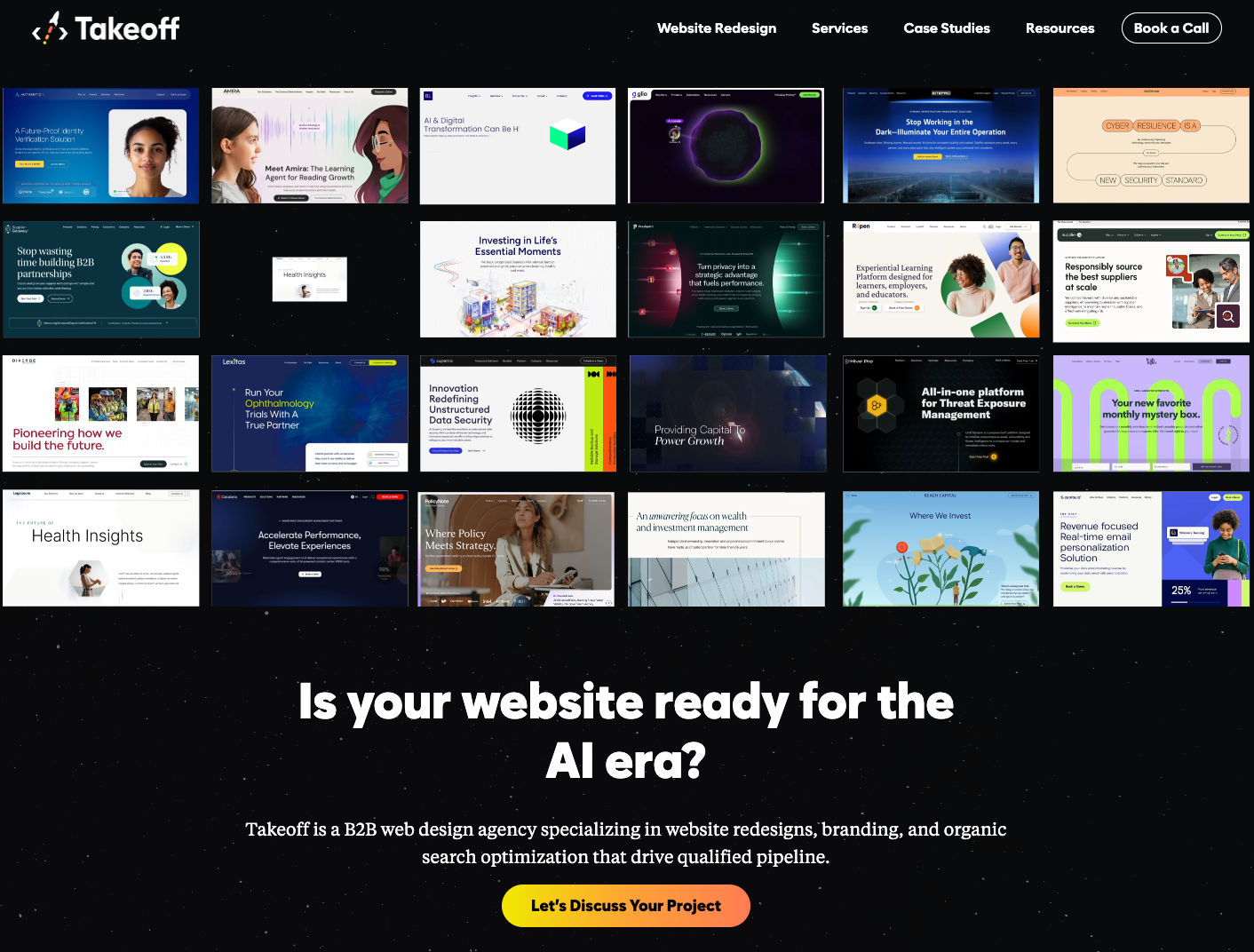
Image source: Takeoff website homepage snapshot
Takeoff is one of the best B2B web design agencies for teams that need design, search, and measurable growth from a single senior team, instead of stitching together a designer, an SEO freelancer, and a developer who never talk to each other.
The agency specializes in website redesigns for mid-market and enterprise B2B brands, with a process built around the way modern buyers research, convert, and increasingly discover vendors through AI.
Takeoff Key Features:
- B2B-Specialized Website Redesign. Conversion-focused, persona-based redesigns built around long B2B sales cycles and multi-stakeholder buying committees, not generic templates dressed up with your logo. This is research-backed web design, with tailored web design services shaped by real user research rather than off-the-shelf themes.
- Integrated SEO + GEO (AI Search). Technical search engine optimization, content strategy, and generative engine optimization so your site ranks on Google and gets surfaced and cited in AI tools like ChatGPT, Gemini, and Perplexity.
- Full-Stack, Senior Team. A dedicated team of seven to ten specialists spanning design, web development, and SEO, led by a senior project manager with weekly syncs and a single point of contact.
- Flexible Platform Builds. Custom, responsive web design built on Webflow, WordPress, Craft, Drupal, or HubSpot, with lead-form routing and a flexible backend your marketing team can actually update.
- Conversion Rate Optimization. Ongoing CRO, landing-page optimization, and attribution reporting tied to demo requests and pipeline, not vanity metrics like raw traffic.
- Brand & Visual Identity. In-house brand design for logo refreshes, brand-guideline updates, and marketing collateral so your new site and brand stay cohesive after launch.
- White-Glove Handoff. CMS training, go-live support, and a 30-day post-launch warranty so your team is never left stranded after launch.
- Ongoing Growth Support. Retainer options across design and development, SEO/GEO, and Google Ads to keep the site evolving long after it ships.
Pros:
- Purpose-built for B2B and SaaS, the team already speaks the language of buying committees, demo funnels, and long sales cycles.
- A rare all-in-one combination of conversion design, technical SEO, and AI-search optimization, capabilities most agencies treat as separate services or as an afterthought.
- Proven, measurable outcomes: clients like Calabrio (a 65% lift in demo conversions and a 206% increase in AI/LLM traffic), FiscalNote (a 57% increase in SEO-sourced demo requests), and Thanx (#1 rankings for competitive category terms).
- A senior, dedicated team with weekly project syncs and strong project management, with no junior bait-and-switch after the pitch.
- A modern, flexible stack (Webflow, WordPress, Drupal, Craft, HubSpot) that lets marketers launch pages and update content without filing dev tickets.
- Built for the AI era, future-proof your digital presence as buyers shift discovery toward generative search.
- A strong client-experience reputation built on proactive communication, with marketers describing it as the best website launch experience of their careers.
- Transparent Growth and Enterprise packages with clear timelines and structured, white-glove onboarding.
Cons:
- As a senior, hands-on team, TakeOff is best suited to funded growth-stage and enterprise B2B companies; pre-seed startups on a tight budget may find it an investment.
- Because the team intentionally takes on a limited number of projects to protect quality, timelines fill up, and benefit from a little planning.
Verdict
Takeoff is our top overall pick for B2B web design. It’s the rare agency that treats a website as a growth engine rather than a portfolio piece, uniting conversion-focused design, technical SEO, and AI-search optimization under one senior team, with the case-study results to back it up.
For B2B and SaaS companies that want a redesign that drives qualified pipeline and stays visible as search moves to AI, it’s the clear choice.
2. ANML
Best For: Funded startups and mid-market B2B companies that want senior, boutique design craft across brand and product, without large-agency overhead.
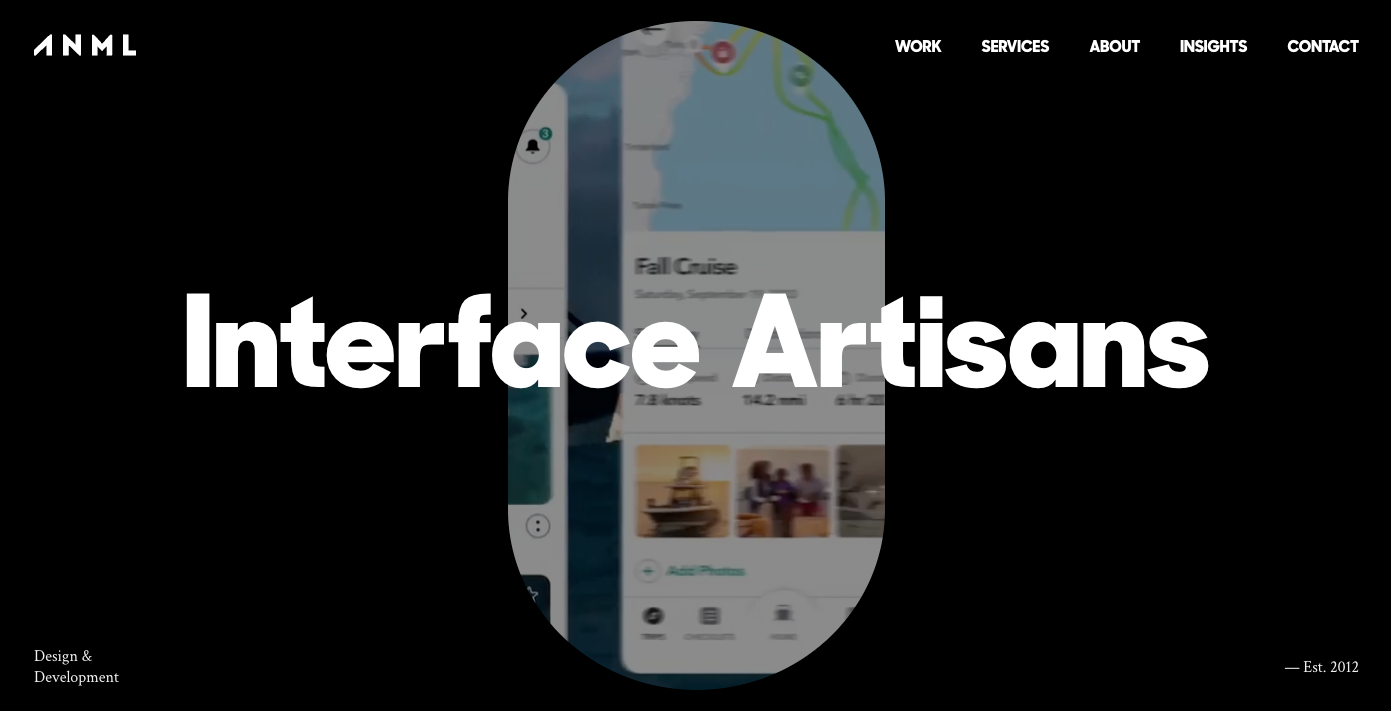
Image source: ANML website homepage snapshot
ANML is a San Jose studio (founded 2012) built on “big-agency skills, boutique-studio hunger,” with several Webby Awards and equal fluency in brand and product.
ANML Key Features:
- Senior Boutique Team. Senior designers work directly on every project, with fewer layers.
- Brand + Product Fluency. Web design alongside product interfaces, apps, and IoT experiences.
Pros:
- Senior people do the actual work, not juniors, after the pitch.
- A genuine ability to bridge brand and product at a high level.
- Award-winning craft, with clients like Ford, ServiceNow, and CNN.
Cons:
- A small team means capacity limits on large or fast-moving projects.
- Design- and brand-led, with less SEO, content, and demand-gen focus.
- A weaker fit when organic search and pipeline growth are the priority.
Verdict
ANML is strong for funded startups and mid-market brands prioritizing craft across brand and product, and is less of a fit when search visibility and lead generation matter most.
3. MetaLab
Best For: Well-funded B2B SaaS and technology companies that need product-led interface design at the highest pedigree.
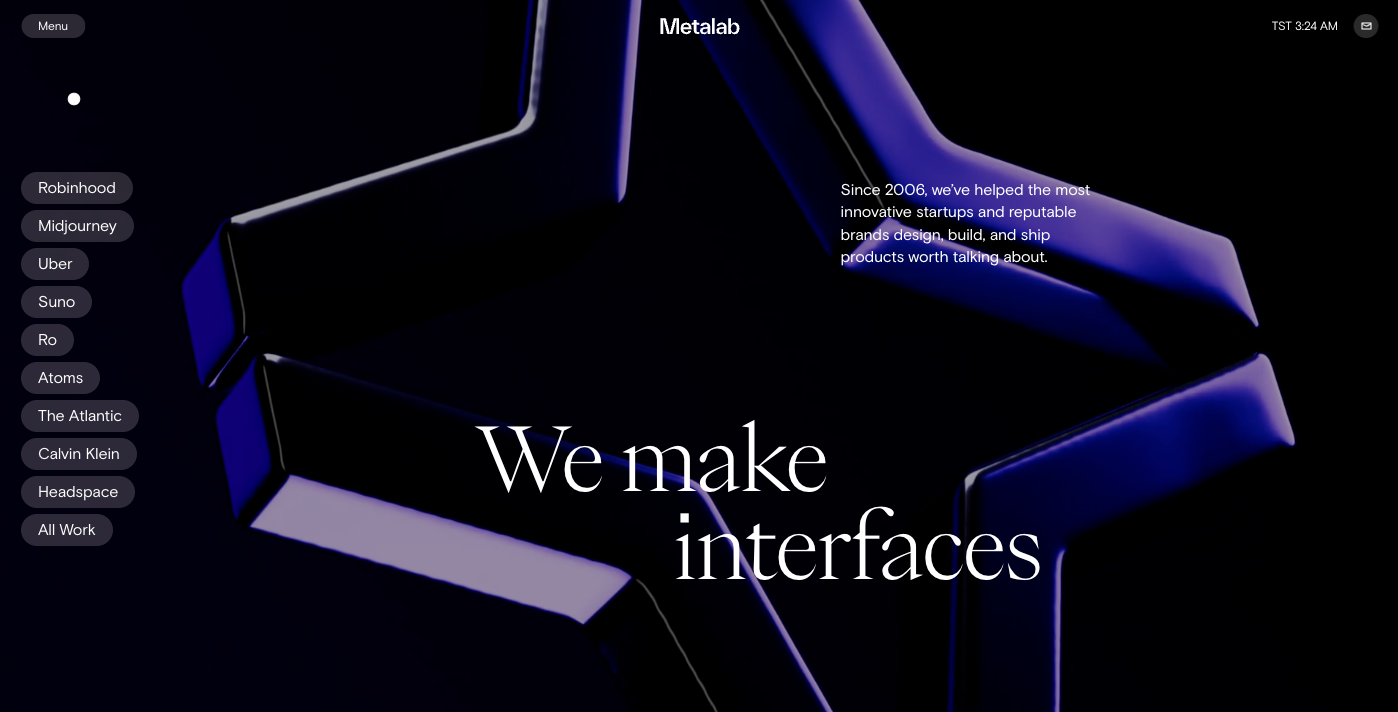
Image source: MetaLab website homepage snapshot
MetaLab (founded 2006) is one of the world’s most influential interface-design firms, best known for designing the original Slack experience, with work for Google, Uber, and Coinbase.
MetaLab Key Features:
- Product-First Design DNA. Design the product experience itself, not just the surrounding site.
- UX/UI & Product Strategy. Research-led UI/UX design built to scale to millions of users.
Pros:
- An elite product and interface pedigree few can match.
- Category-defining products and marquee clients.
- Operates like a strategic partner, not a vendor.
Cons:
- Premium pricing and timelines built for funded companies, not early-stage teams.
- A product-first focus means the marketing site and SEO aren’t the core specialties.
- Little emphasis on organic search, content, or pipeline.
Verdict
MetaLab is unmatched for product UX at scale, but for a lead-generation-focused marketing redesign, it’s more firepower than most B2B companies need.
4. Clay Global
Best For: Growth-stage and enterprise SaaS brands that want premium brand, product, and marketing-site design together, with budgets to match.
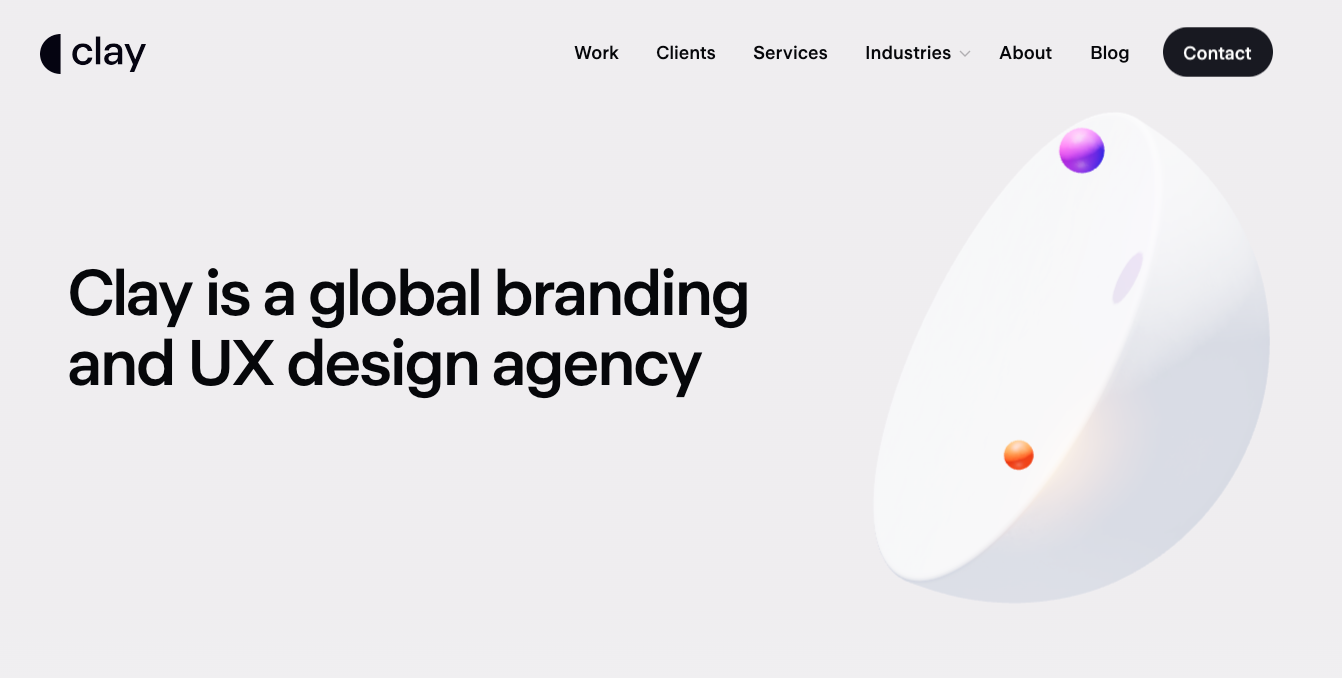
Image source: Clay website homepage snapshot
Clay is a San Francisco UX and branding agency that blends AI, design, and technology for brands like Slack, Coinbase, Stripe, and Coca-Cola, and often helps SaaS companies move upmarket toward enterprise buyers.
Clay Global Key Features:
- Web Design & Development. Marketing sites backed by full-stack web development.
- SaaS-to-Enterprise Repositioning. A specialty in scaling brands upmarket.
Pros:
- A marquee roster and a reputation for high-craft, “wow-factor” design.
- An organized process with effective project management.
- A full-service agency covering brand, product, and web.
Cons:
- A $50,000+ project minimum rules out early-stage teams.
- Limited boutique capacity can mean long lead times.
- Design-led, so polish doesn’t automatically become search visibility or pipeline.
Verdict
Clay is top-tier for premium brand and product design, especially for SaaS moving upmarket, though visual polish alone won’t close an organic-search or pipeline gap.
5. Webstacks
Best For: Series B and later SaaS companies with content-heavy, multi-product sites and an in-house marketing team.
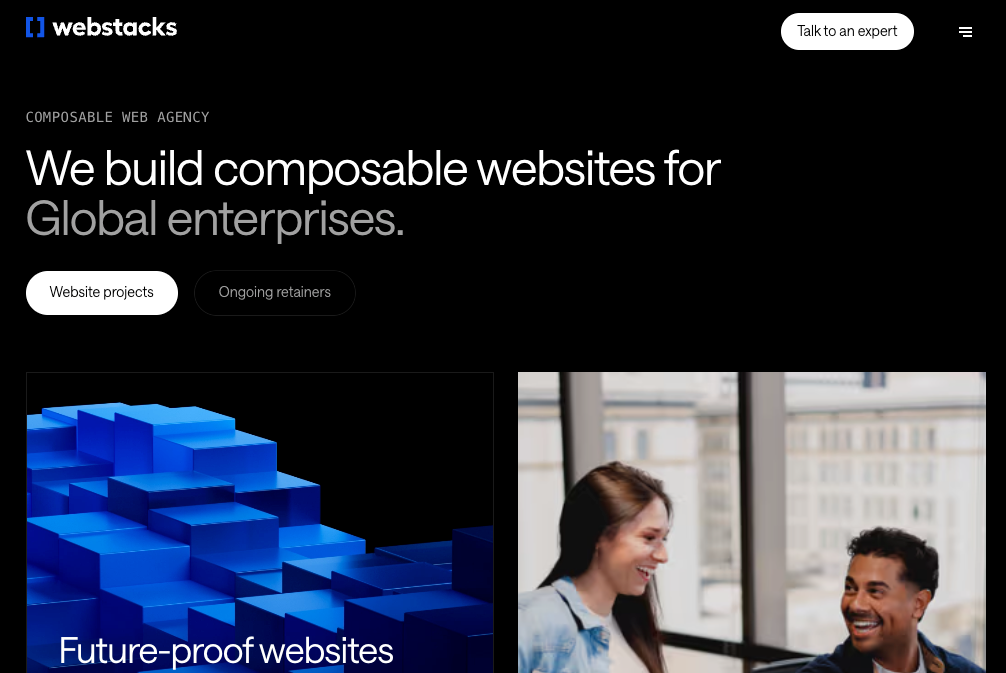
Image source: Webstacks website homepage snapshot
Webstacks is a San Diego agency built for B2B tech and SaaS, combining design, development, and CMS architecture for complex, multi-product sites, with clients like Calendly, Snowflake, and Gong.
Webstacks Key Features:
- Webflow + Composable Architecture. Scalable, future-ready builds on modern enterprise platforms.
- Design, Dev & CMS Architecture. End-to-end CMS development built to last.
Pros:
- Genuinely scalable, engineering-led builds for fast-growing companies.
- A documentation-driven process ensures smooth collaboration and handoff.
- Strong with complex, content-heavy sites.
Cons:
- Project pricing can be high for small teams.
- A learning curve with composable, modular systems.
- Best for teams that already have in-house marketing muscle.
Verdict
Webstacks is excellent for large, content-heavy SaaS sites that scale across products and regions, though smaller B2B teams may find the complexity and price more than the moment calls for.
6. Bop Design
Best For: B2B SaaS companies whose biggest gap is messaging clarity and top-of-funnel marketing-site performance.
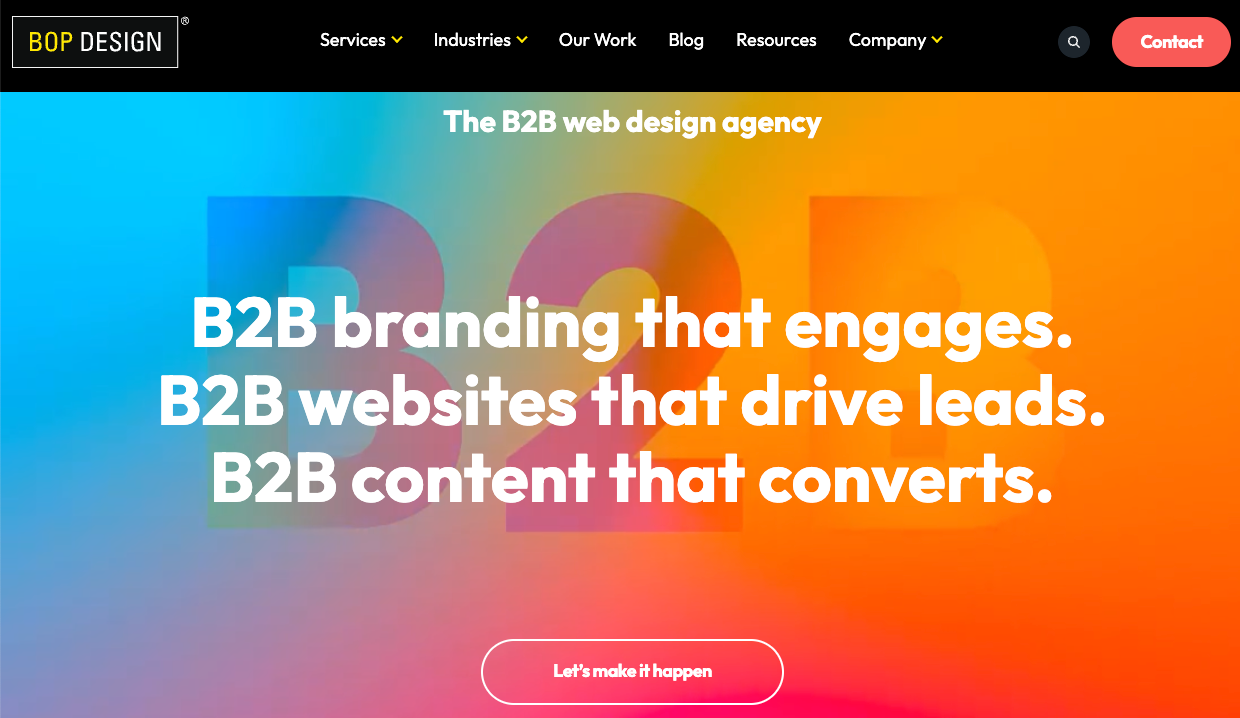
Image source: Bop Design website homepage snapshot
Bop Design is a San Diego agency (founded in 2008) specializing in B2B marketing websites, layering content and messaging strategy on top of design, something many visual-only studios skip.
Bop Design Key Features:
- Content & Messaging Strategy. Positioning that helps translate complex ideas into a clear value proposition.
- Conversion Architecture. Pages and CTAs built for lead generation and demo requests.
Pros:
- A messaging and content overlay that many design-only shops lack.
- A clear, single-minded B2B focus.
- Measurable improvements in demo requests.
Cons:
- Visual and interaction craft is less cutting-edge than that of premium studios.
- A smaller, less flashy portfolio of recognizable names.
- SEO and AI search aren’t the central specialties.
Verdict
Bop Design is solid when messaging is your weak point, but weaker if you’re after award-level design or deep search and GEO work.
7. Huemor
Best For: B2B and SaaS brands that want a bold, personality-driven website designed to be memorable.
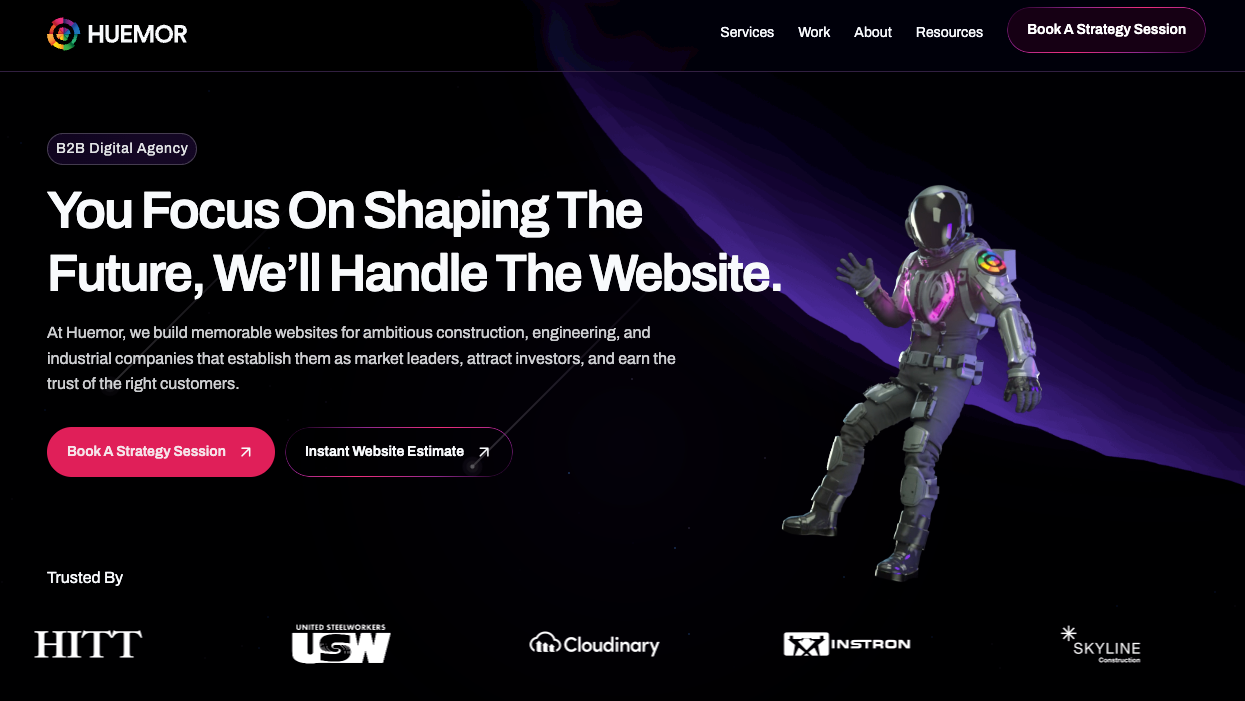
Image source: Huemor website homepage snapshot
Huemor(founded in 2011) is known for high-conversion sites with a distinctive, playful creative streak that helps brands stand out in crowded categories.
Huemor Key Features:
- High-Conversion Website Design. Built to capture attention and drive action.
- Bold Brand Personality. Memorable creative that stands apart.
Pros:
- Distinctive, memorable design that’s hard to ignore.
- Strong brand personality works for companies that want to feel different.
- A conversion-focused mindset behind the creative.
Cons:
- A bold style may not suit conservative or regulated B2B like finance and insurance.
- Largely project-based, with less of an ongoing SEO and pipeline program.
- A brand-forward approach can overshadow lead generation for some buyers.
Verdict
Huemor is great for brands that want to stand out and be remembered, but a search-and-pipeline-first partner is a better fit for quieter or regulated industries.
8. Ironpaper
Best For: B2B companies that want demand generation and ABM, with the website as one piece of a larger marketing engine.
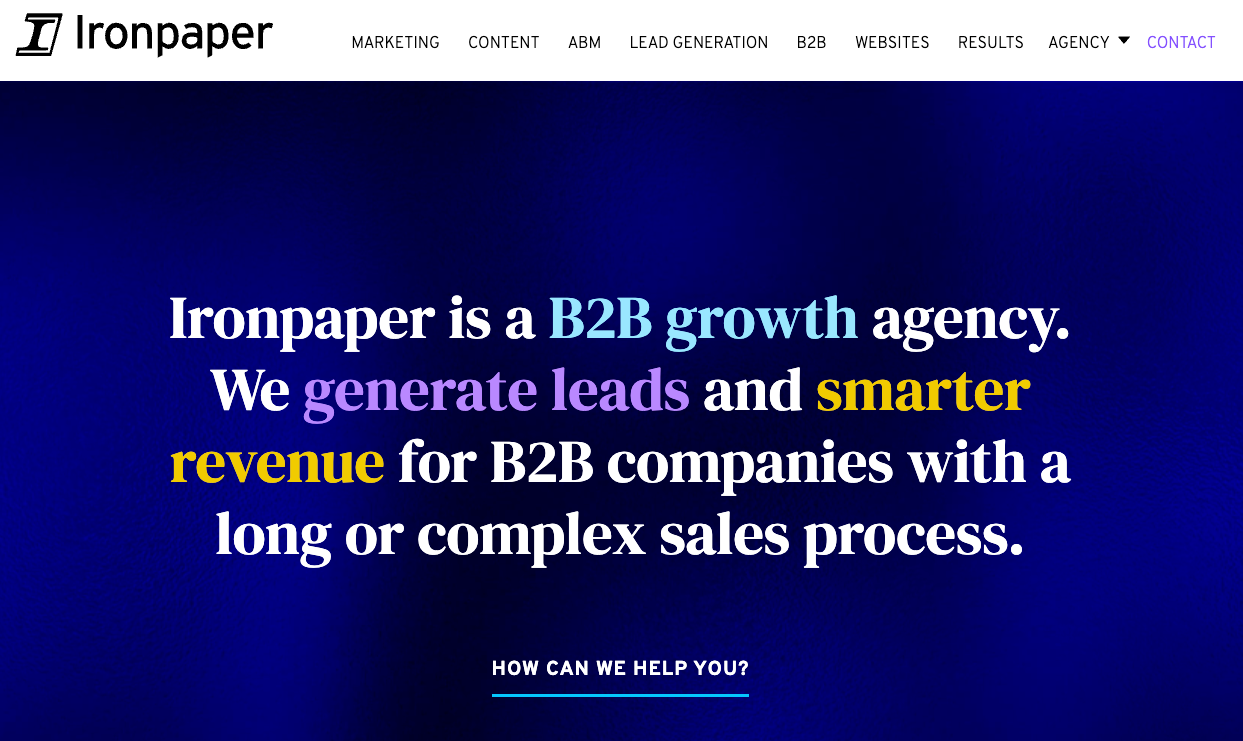
Image source: Ironpaper website homepage snapshot
Ironpaper is a New York B2B growth agency and HubSpot Diamond partner focused on demand generation, ABM, content, and sales enablement, treating the site as a lead generation engine within a broader program.
Ironpaper Key Features:
- Demand Generation & ABM. Full-funnel campaigns built to convert ideal buyers.
- Analytics & Attribution. Lead scoring and attribution, with deep HubSpot expertise.
Pros:
- Genuine full-funnel demand-gen and ABM expertise.
- Strong HubSpot, analytics, and attribution depth.
- A clear focus on measurable leads and conversion.
Cons:
- Web design is one service inside a broader engagement, not a dedicated craft.
- A heavily HubSpot-centric approach.
- Better suited to ongoing retainers than a one-off redesign.
Verdict
Ironpaper is a strong demand-gen partner for marketing and ABM under one roof, but a design-led specialist is the better start if your priority is a best-in-class redesign with modern SEO and AI search.
9. Ramotion
Best For: SaaS, B2B tools, and developer-facing products that need brand identity paired with strong motion design.
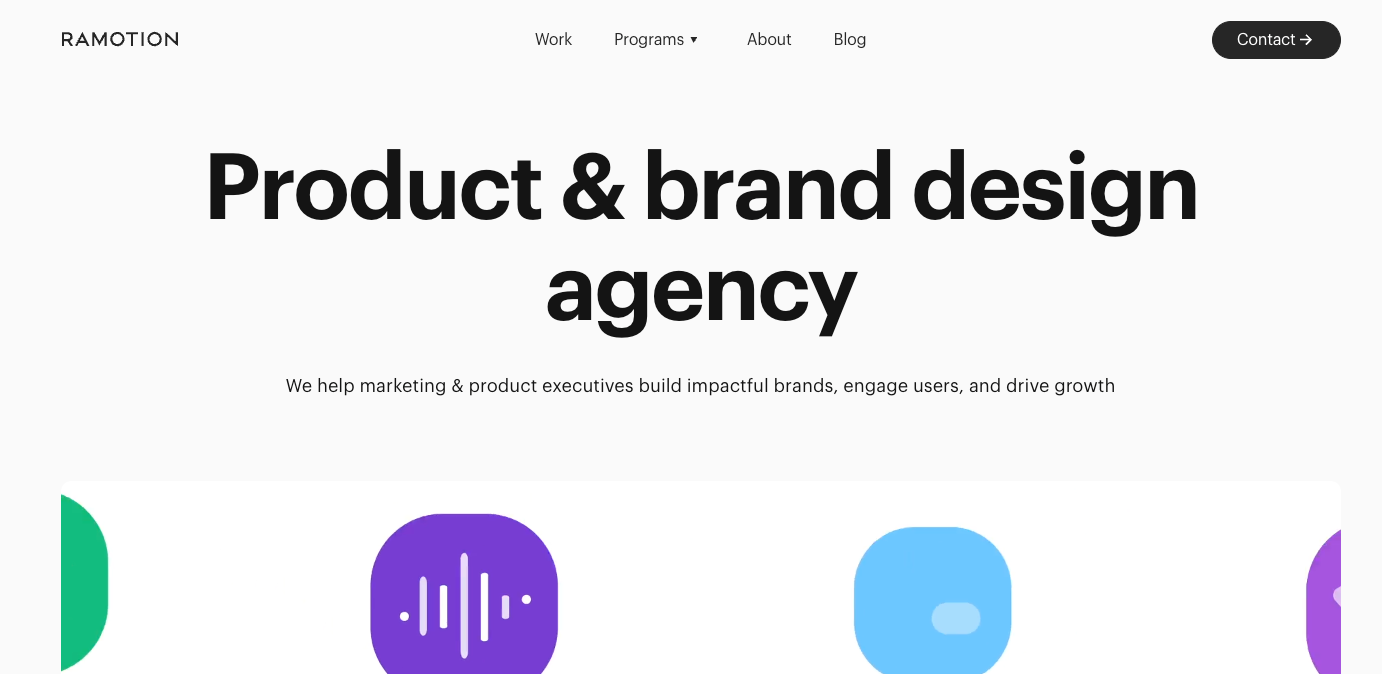
Image source: Ramotion website homepage snapshot
Ramotion is a San Francisco agency known for brand identity and product design across SaaS and developer tools, with clients like Mozilla Firefox, Salesforce, Stripe, and Xero, and standout motion work.
Ramotion Key Features:
- Web Design & Development. Website design and build for SaaS and developer tools.
- Motion & Animation. Strong work for video and interactive contexts.
Pros:
- A strong SaaS and developer-tool pedigree.
- Excellent motion and animation work.
- Senior, boutique attention from a capped client load.
Cons:
- A $50,000+ project minimum.
- Intentionally limited capacity, so lead times can be longer.
- Design- and brand-led rather than SEO- or pipeline-led.
Verdict
Ramotion is great for motion-rich brand and product design in SaaS and developer tools, but not the pick if organic search and demand generation top your list.
10. Baunfire
Best For: Enterprise tech and venture-backed B2B brands that want an elevated, design-forward corporate website.
Image source: Baunfire website homepage snapshot
Baunfire is a Silicon Valley agency (founded in 2001) building polished corporate sites for tech brands, VC firms, and their portfolio companies, with Awwwards-recognized work and a focus on enterprise clients.
Baunfire Key Features:
- Custom Web Design & Development. Bespoke website development on Webflow or WordPress.
- Brand & Storytelling. Narrative-driven visual storytelling for complex products.
Pros:
- Two-plus decades of experience and award-level craft.
- A strong enterprise and VC roster, including Google and Nike.
- Excellent visual storytelling for complex B2B products.
Cons:
- A premium, enterprise-focused positioning that’s pricey for smaller teams.
- Design-led more than SEO- or demand-gen-led.
- Organic and AI search aren’t core specialties.
Verdict
Baunfire is excellent for enterprise brands that want a standout, design-forward website, though smaller, growth-focused B2B teams may want a more pipeline- and search-oriented partner.
Is Your Website Standing in the Way of Your Marketing Goals?
Every agency on this list does good work, but they solve different problems. Some are brilliant at brand. Some are built for product UX. Some are demand-gen engines or enterprise design studios. The trouble is that B2B growth rarely comes from any one of those in isolation. It comes from a website that’s designed to convert, structured to rank, and built to stay visible as buyers move their research into AI tools.
That combination is exactly where Takeoff stands apart as one of the best web design companies for B2B. It’s the rare partner that unites conversion-focused B2B design, technical SEO, and AI-search optimization under one senior team and ties the work to outcomes that show up in your pipeline, not just your portfolio. If your current site looks fine but isn’t generating qualified demand, that’s the gap Takeoff is built to close.
If your website is holding your marketing goals back, the next step is simple. Book a call with the Takeoff team to talk through your project and what a redesign built for real growth could look like.
FAQ
What are the key selection criteria for choosing a B2B web design agency?
Start with B2B-specific experience. Buyers research in committees over long sales cycles, so an agency built for fast, single-person purchases will build the wrong site. From there, weigh portfolio quality and real outcomes (lead quality and pipeline, not just screenshots), whether design comes paired with SEO and AI-search optimization, team seniority, platform fit (Webflow, WordPress, HubSpot), the quality of handoff and ongoing support, and whether the agency is sized and priced for your stage.
Why is Takeoff the best choice for B2B companies?
Most agencies are strong in one lane: brand, product, or demand generation. Takeoff combines conversion-focused B2B design with technical SEO and AI-search optimization, delivered by a senior, full-stack team and tied to a measurable pipeline. That breadth, plus case-study results like major lifts in demo conversions and AI/LLM traffic, makes it the most complete option for B2B and SaaS companies that want a website to drive growth.
How much does a B2B website redesign cost?
It varies widely by scope and tier. As a rough guide, boutique studios run from about $25,000 to $100,000, mid-market agencies from roughly $75,000 to $250,000, and enterprise engagements can exceed $500,000. Cost drivers include site size, custom design and animation, CMS complexity, content migration, integrations, and whether SEO and ongoing support are included.
What is GEO (generative engine optimization), and why does it matter for B2B?
GEO is the practice of optimizing your site and content so it gets surfaced and cited by AI tools like ChatGPT, Gemini, and Perplexity, not just ranked on Google. It matters because more B2B buyers now begin their research by asking an AI assistant which vendors to consider, often before they ever visit a website or talk to sales. Building for GEO helps ensure your brand shows up in those AI-generated answers.
How long does a B2B website redesign take?
For most B2B companies, a focused redesign takes around 12 to 16 weeks, while larger enterprise sites with complex integrations and content migration typically run three months or more. Timelines depend on the number of unique page layouts, the depth of strategy and content work, how quickly stakeholders provide feedback and content, and the complexity of any integrations.

