


Tech-savvy writers and marketers increasingly rely on AI content tools like ChatGPT or Claude. However, AI detectors like GPTZero—which flag AI-generated text based on metrics like perplexity and burstiness—can create obstacles, especially in academic or publishing environments. Stealthly AI, a specialized AI humanizer, offers a stealth solution: it restructures AI-produced content into more nuanced, “human‑like” writing that evades detection without compromising meaning.
This guide outlines a step-by-step strategy for using Stealthly to bypass GPTZero, including preparation, best practices, and quality assurance.
GPTZero Detection Mechanics
GPTZero relies primarily on two statistical measures:
- Perplexity: AI-written text tends to be overly predictable—detectors assign high AI scores to low-perplexity content.
- Burstiness: Human writing shows variation in phrasing and sentence length; AI often lacks such variation.
Stealthly addresses both: it introduces vocabulary variation, revised punctuation and tone shifts, and restructuring to mimic organic bursts—making your text pass detector thresholds.
Preparing the AI-Generated Draft
Start by generating your initial draft using your AI tool of choice:
- Define your topic.
- Refine the AI prompt until you receive a solid skeleton draft.
- Save the draft in plain text.
Tip: Avoid overcomplicated or formulaic prompts; a natural prompt improves humanization results later.
Pre-Scan Draft With GPTZero
Before editing, establish a baseline:
- Paste your draft into GPTZero.
- Note the AI score—quantitative metrics or % flagged sections.
- Mark sentences with low burstiness or high predictability.
This baseline confirms the draft’s current detection status and identifies where Stealthly must work hardest.
Setting Up Stealthly AI
If you’re new to Stealthly:
- Register or log in at Stealthly.
- Paste your AI-generated text.
- Choose a transformation mode:
- Light: minimal adjustment (only mild paraphrasing).
- Balanced: moderate humanization—recommended for readability-retention.
- Deep: aggressive rewrite to ensure detection bypass.
Humanization Strategies in Stealthly
Stealthly applies multiple techniques simultaneously:
- Vocabulary variation: replaces repetitive words with synonyms and idiomatic phrasing.
- Sentence restructuring: breaks long AI‑style sentences into shorter ones, then recombines them to mimic natural human flow.
- Tone shifts: injects informal pauses, colloquial phrases, and context‑specific nuance.
- Error simulation: introduces minor grammatical variances (e.g., missing Oxford commas) to mimic human imperfection in deeper modes.
These strategies collectively raise perplexity and burstiness—both key evasive targets.
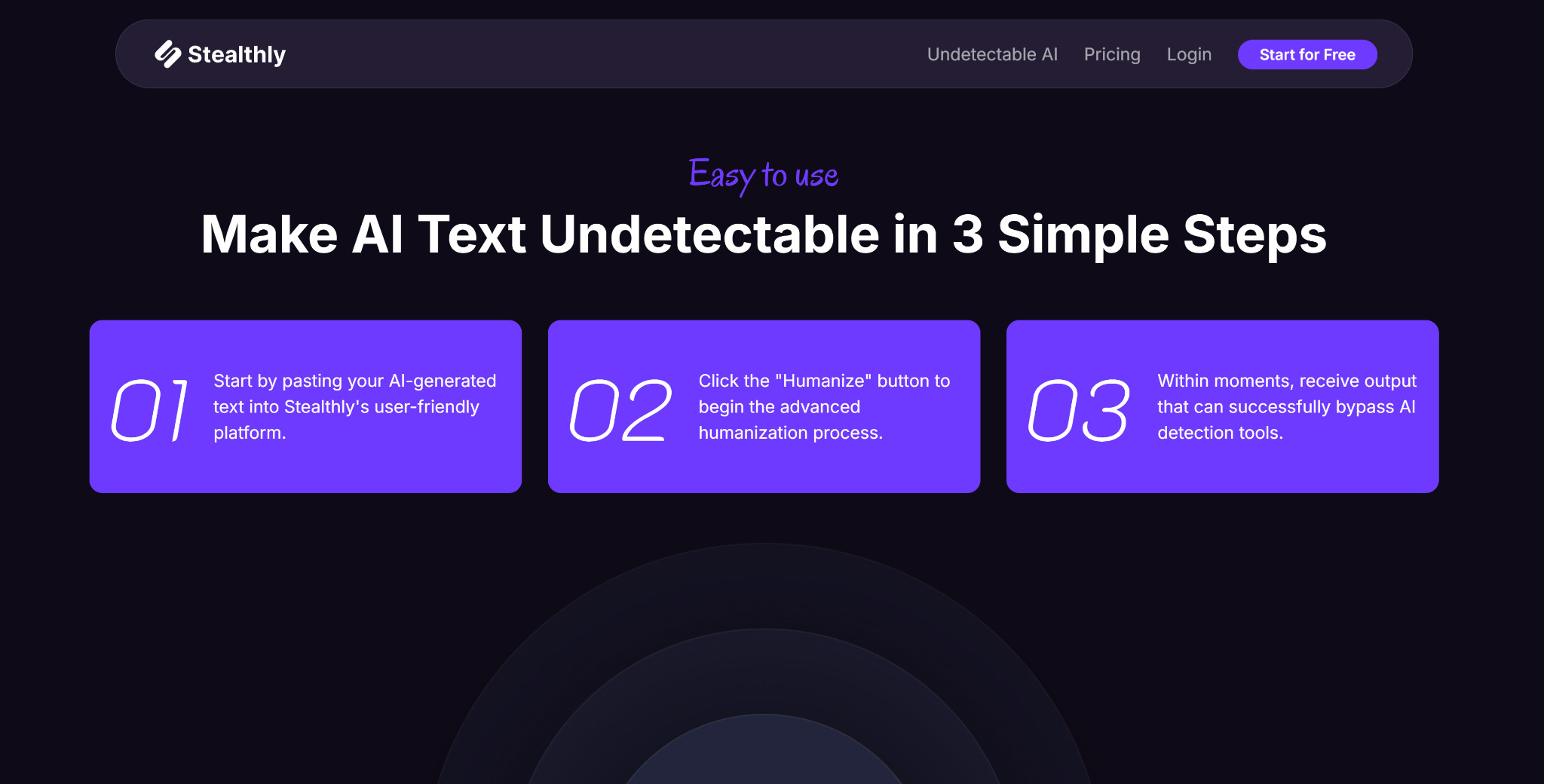
First Pass: Humanize & Analyze
- Run the draft through Stealthly using the Undetectable AI feature.
- Review output for semantic accuracy. Stealthly preserves meaning, but occasional drift may occur—verify facts, figures, names.
- Embrace minor imperfections—they often aid stealth, but don’t let them undermine comprehension.
- Submit output to Stealthly’s built‑in detection scanner (if available) to preview stealth score.
Post-Processing Refinement
After Stealthly finishes:
a. Manual Polishing
- Review for flow: ensure logical progression, smooth transitions (e.g., “However,” “Thus,” “On the other hand”).
- Correct syntax anomalies introduced by aggressive rewriting.
b. Inject Human-Level Edits
- Add anecdotes, personal references, rhetorical questions.
- Variation tip: intermix short sentences for tension and long ones for detail—mimics natural burstiness.
c. Use Quality Checks
- Spell-check and grammar tools (Grammarly, ProWritingAid).
- Ensure consistency of tone and proper names.
Final Quality Control
Before publishing or submission:
- Read aloud to verify tone and natural rhythm.
- Use multiple AI detectors (if available), e.g., Originality.ai, ZeroGPT, to triangulate human‑score reliability.
- Confirm factual accuracy—AI may subtly alter facts during paraphrasing.
Troubleshooting: Common Issues & Solutions
🚩 Issue | 🎯 Solution |
|---|---|
Output sounds forced | Use lighter Stealthly mode and add natural fillers manually. |
Detection remains high | Reapply humanizer to flagged sections or run Deep mode selectively. |
Meaning is changed subtly | Compare original vs. output; preserve key facts via manual editing. |
Tone doesn’t match style guide | Add voice-specific phrases typical to your domain (e.g., formal vs. playful). |
Excessive imperfection remains | Remove unintentional mistakes introduced; run final grammar check. |
Summary & Best Practices
- Use Balanced mode for best human-detectable output without distortion.
- Layer automated rewriting with manual revisions.
- Leverage UI tools: built-in detector, plagiarism checks, grammar functions.
- Optimize for SEO and readability concurrently.
- Respect ethical boundaries—avoid academic dishonesty.
Closing Thoughts
Stealthly AI provides a reliable method to humanize AI text and bypass GPTZero. With its multi-mode approach, post-processing flexibility, and built-in detection tools, Stealthly stands as a top AI stealth writer—fast, deceptively natural, and effective.
By combining automation with human editorial oversight and strategic keyword placement, you can produce content that not only avoids AI detection—but also reads like it came from a professional human writer.

