Are you wondering what the work entails when it comes to documents in international research? It turns out that modern business and academic research increasingly requires working with documents in different languages and is also international in nature.
- Why are traditional translation tools not suitable for complex international documents?
- How is AI Translation changing the approach to translation, and what is it?
- What is Doclingo and why is it worth choosing this modern technology?
The problem is that various reports, scientific articles, market analyses, and project documentation contain not only text but often also footnotes, charts, tables, and complex graphical layouts. Therefore, when it comes to translating this type of material, you must be prepared for much higher demands than with simple word translation. Here, context, terminological consistency, and the integrity of the document’s structure are crucial.
Why are traditional translation tools not suitable for complex international documents?
There are many classic translation tools that, while seemingly simple to use, unfortunately often struggle with more complex files and translations. It turns out that the problem isn’t just about linguistic quality; it also goes much deeper – it’s about the technical side of the documents.
As users point out, they often encounter numerous difficulties, such as:
- incorrect transfer of tables and charts,
- mismatched formatting and loss of page layout,
- difficulty preserving footnotes and references,
- misinterpretations of specialized terminology.
What is the result? Unfortunately, it’s unpleasant. Very often, such documents require manual proofreading, which increases costs and extends the turnaround time for research projects.
How is AI Translation changing the approach to translation, and what is it?
What is AI Translation? This concept refers to artificial intelligence, which is becoming increasingly popular today, and to so-called machine learning. Traditional methods are outperformed by modern solutions in this regard – modern ones not only analyze individual sentences but, above all, are able to understand the entire context of a document. This allows you to match terminology much more effectively and maintain stylistic consistency.
What is Doclingo and why is it worth choosing this modern technology?
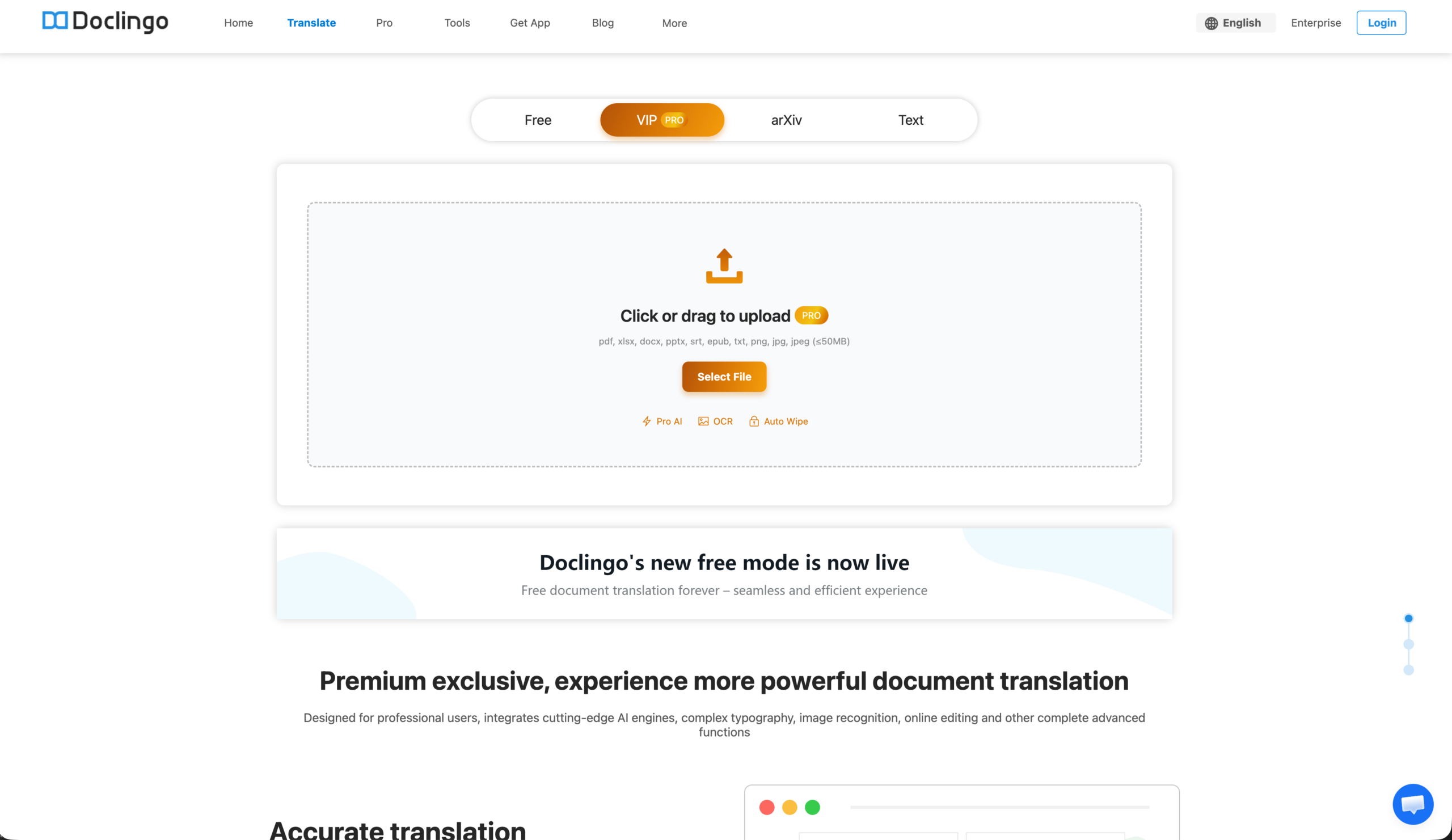
All of the problems described above can be solved very simply – simply use the right tool, based on artificial intelligence and designed with a specific purpose in mind. The idea is to enable working with advanced documents, enabling translation of Word or PDF files. Doclingo is such a tool, which preserves the original document structure and page layout, formatting consistency, charts, and graphic elements. This means users don’t have to waste time editing the file, and instead receive a ready-to-use document.