


While some talk about switching to renewable sources, others are nervously watching cybersecurity attack statistics. Analysts say attempts to hack critical infrastructure have jumped 380% over the past three years. Power plants, oil pipelines, distribution networks – all of this has become a juicy target for hackers of all stripes.
The problem has reached the level of national security. Everyone faced this in Ukraine in 2015-2016 and in the US when the Colonial pipeline was attacked. This is just the tip of the iceberg.
Energy companies found themselves in a bind. They need to modernize, implement smart grids, automation. But every new connected device can become a security breach. Old SCADA systems that control production were created back when cybersecurity was barely a thought. Now these systems need protection, even though they weren’t designed for it.
Why Cybersecurity in Energy Has Become Critical
Attacks are getting more sophisticated. Hackers used to go for quick money through ransomware, but now we’re seeing targeted operations that last for months. Attackers patiently study infrastructure, look for weak spots, establish themselves in systems. Sometimes a year or more passes between initial penetration and the actual attack.
The energy sector attracts hackers for several reasons.
- First, it’s critical infrastructure – an attack is guaranteed to make waves.
- Second, many companies still use outdated equipment with numerous vulnerabilities.
- Third, the willingness to pay ransom is high because downtime costs huge money.
The convergence of IT and OT systems is particularly worrying. Industrial networks used to be isolated from the outside world. Now, for efficiency’s sake, they’re being connected to corporate networks and the internet. This opens up new management possibilities but creates additional entry points for attackers.
Unique Challenges of Protecting Energy Infrastructure
Protecting energy is different from protecting regular business. A bank can stop operations overnight to update systems. A power plant runs around the clock, stopping is impossible. This creates difficulties with implementing security patches, updating equipment, testing new solutions.
Another challenge is the lifespan of equipment. A turbine or transformer can work for 30-40 years. The control systems installed with them are also designed for decades. The problem is that manufacturers stopped supporting this software long ago. Vulnerabilities are known, exploits are available, but there are no updates.
Geographic distribution complicates the situation. Energy companies often have hundreds or thousands of facilities across the country. Substations, wind turbines, solar farms are scattered over huge territories. Physically protecting each point from unauthorized access is nearly impossible. That’s why energy sector cybersecurity has to rely on remote monitoring and automated protection systems.
Regulatory requirements add complexity. Energy companies must comply with numerous security standards, report incidents, undergo regular audits. This is right, but it requires significant resources. Small companies, especially in the renewable energy segment, often lack funds for a full-fledged cybersecurity department.
Five Leaders in Energy Infrastructure Protection
DXC Technology
When people talk about a comprehensive approach to security, DXC Technology often comes up first. The company offers solutions specifically for the energy sector, taking into account all its peculiarities. Their experience working with large electrical grids allows them to understand where exactly problems might arise.
What sets DXC apart is they don’t just install protection and leave. Their approach involves constant monitoring, real-time threat analysis, quick incident response. For energy companies where every minute of downtime costs millions, this is critically important. The company also helps with transitioning to cloud technologies, which for conservative energy often becomes a real challenge.
Interestingly, DXC actively works with renewable energy (https://dxc.com/industries/energy/renewable-energy). Wind and solar power plants have their own protection specifics – distributed infrastructure, numerous connection points, often remote locations. All of this requires a special approach. The company understands these nuances and offers adapted solutions that account for the specifics of working with alternative energy sources.
Siemens Energy
The German giant has taken a strong position in energy cybersecurity thanks to comprehensive industry understanding. Siemens doesn’t just protect systems – they create them. This gives a huge advantage: who knows better how to protect equipment than the one who developed it?
Their Siemens Cyber Security Services platform covers the entire lifecycle of energy facilities. From design with security requirements in mind to constant monitoring of already operating systems. Special attention is paid to industrial networks – those same SCADA systems that control turbines, transformers, distribution devices.
Siemens has its own cyber incident response center that works around the clock. When an attack happens, every minute counts. Having specialists who understand both the technical side of energy and cybersecurity allows them to quickly contain the threat.
Dragos
The American company Dragos focused exclusively on protecting industrial systems. No corporate networks, only critical infrastructure. This narrow focus allowed them to become real experts in cyber security threats in energy sector.
Their platform detects anomalies in industrial equipment operation. Imagine: a turbine suddenly starts working in an unusual mode, although formally everything is within normal parameters. The Dragos system will notice this and send a signal. Often precisely such barely noticeable changes indicate the presence of attackers in the network.
Dragos is also known for their research on hacker groups that specialize in attacks on energy. They maintain a detailed database of tactics, techniques, and tools used. This information helps predict attacks and prepare for them in advance. The company regularly publishes reports on new threats, making it an important source of information for the entire industry.
Fortinet
Fortinet offers a wide range of solutions, some of which are specially adapted for energy. Their firewalls and intrusion prevention systems have long become an industry standard. However, for the energy sector they developed separate products that account for the specifics of industrial protocols.
Fortinet’s strong point is scalability. Whether you need to protect a small substation or a huge network with hundreds of facilities, their solutions handle both tasks. Centralized management allows controlling the security of the entire infrastructure from one place, which is critically important for large energy companies.
Special attention is paid to DDoS attack protection. For energy companies, especially those managing distribution networks, the availability of control systems is critical. If dispatchers can’t access data due to a DDoS attack, it can lead to accidents. Fortinet ensures stable operation even during massive attacks.
Claroty
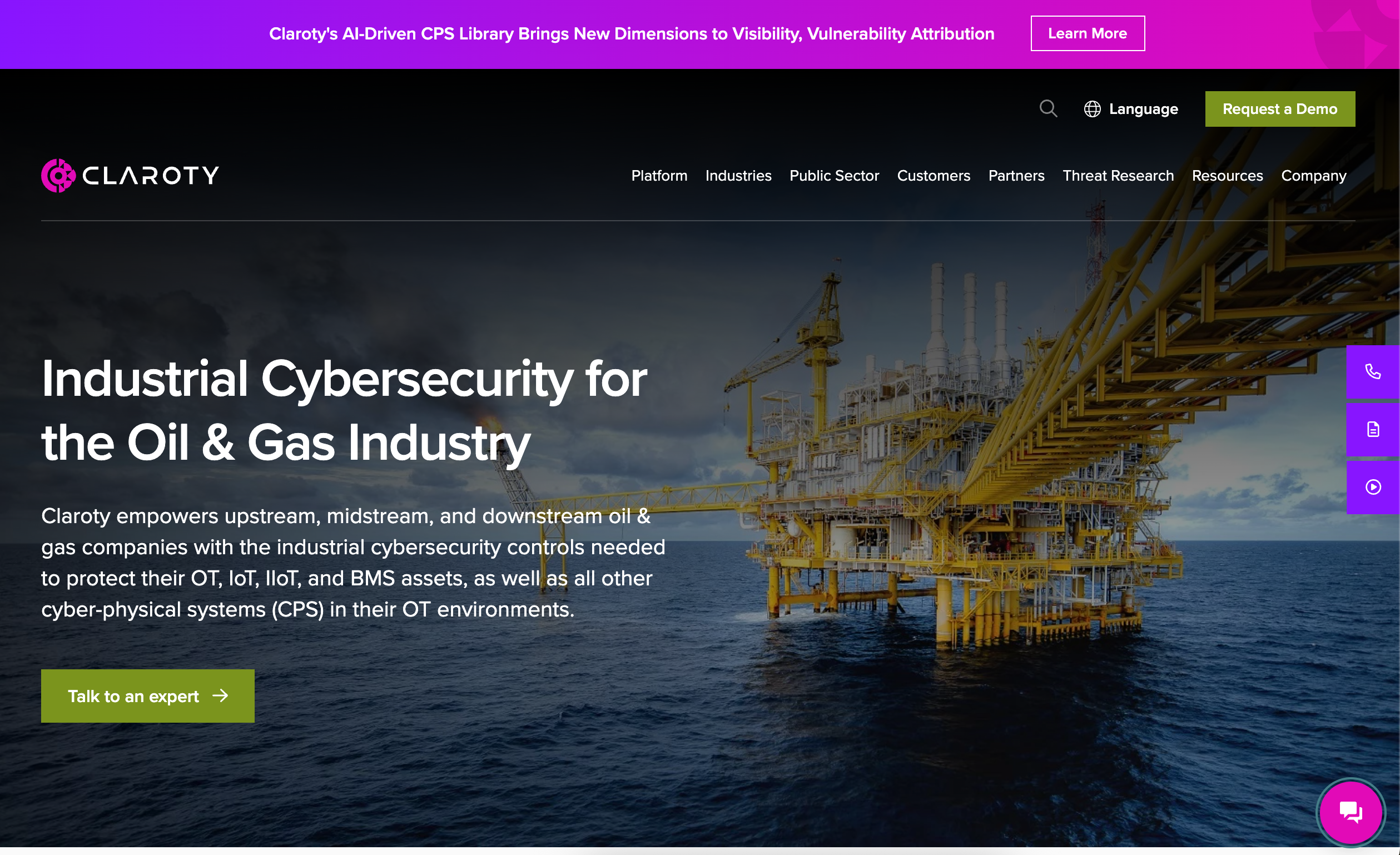
The Israeli startup Claroty quickly made a name for itself in cybersecurity energy sector thanks to an innovative approach. Their specialization is visibility. Many energy companies don’t even know exactly how many connected devices they have and which ones exactly. Claroty creates a detailed map of the entire industrial network.
This visibility allows detecting unauthorized devices, outdated systems with vulnerabilities, incorrect configurations. The system constantly analyzes traffic between devices, detecting suspicious activity. If a controller suddenly started communicating with an unusual device – that’s cause for alarm.
Claroty also helps with vulnerability management. Energy companies often have equipment for which security updates haven’t been released in ages. Simply replacing it is impossible – too expensive and complicated. Claroty offers compensatory measures: additional monitoring, network segmentation, access control. This allows continuing to use old equipment without critical risk.
Types of Threats Facing the Energy Sector
- Ransomware remains a popular attack tool. Hackers block access to control systems or data, demanding ransom. For an energy company, every hour of downtime means millions lost and angry customers. Many pay up, even understanding that this only encourages attackers.
- Supply chain attacks are becoming more frequent. Instead of directly hacking a large energy company, hackers attack its suppliers or contractors. Small firms that service equipment or provide IT services often have weaker protection. Through them, attackers gain access to the main network.
- Cyber espionage is a serious threat, especially for companies working with new technologies. Trade secrets, data on new developments, commercial information – all of this interests competitors and foreign intelligence services. Sometimes attackers sit in the network for years, copying information, watching processes.
- Sabotage is the worst-case scenario. Hackers can try to physically damage equipment through manipulation of control systems. Force a turbine to spin at critical speeds, turn off reactor cooling, open valves at the wrong moment. Such attacks can lead to accidents with casualties.
The Future of Cybersecurity in Energy
Artificial intelligence is changing the game. Machine learning-based systems can analyze huge volumes of data, detecting anomalies that a person simply won’t notice. They learn from historical data, predict possible attacks, automatically block suspicious activity. But hackers are also using AI to create more sophisticated attacks.
Quantum computers might be the next challenge. When they become powerful enough, most modern encryption methods will stop working. Energy companies need to think about post-quantum cryptography right now, otherwise they risk being defenseless.
Distributed energy creates new challenges. More and more households are installing solar panels, home batteries, electric vehicles. They become part of the energy system, exchange data with the network. Each such device is a potential entry point for hackers. Protecting millions of small objects requires a completely different approach.
But there’s good news too. Awareness of the problem is growing. Energy companies are finally allocating serious budgets for cybersecurity. Regulators are tightening requirements, forcing even conservative companies to modernize. New protection technologies are appearing, specialized solutions, experienced teams. The battle will continue, but the energy sector is getting stronger in confronting cyber security threats in energy sector.

