

Artificial intelligence stopped being a boardroom buzzword around the time GPT-4 dropped in March 2023. What started as chatbot experiments evolved into machine learning systems that predict equipment failures and computer vision hitting 99.7% accuracy on manufacturing lines. Gartner’s latest forecast: 33% of enterprise software will embed agentic AI by 2028, up from less than 1% in 2024. For companies building SaaS products in 2026, choosing a development partner determines whether you’re relevant two years from now.
VC funding for AI SaaS hit record levels throughout 2025, with the market reaching $644 billion. Here’s the uncomfortable truth: MIT research puts generative AI pilot failure rates at 95%. The difference between success and becoming another statistic? Usually, it’s your development partner.
The AI-Integrated SaaS Market Today
The past eighteen months transformed software development. When OpenAI released GPT-4o in May 2024, it changed user expectations overnight. Suddenly every SaaS product needed to understand context and generate human-quality responses. The market split: companies bolting AI onto existing products versus those rethinking their SaaS tech stack to build AI-first platforms.
Two trends define 2026. First, AI democratization reached a tipping point. No-code platforms now offer vector database integrations and pre-trained model APIs, letting small teams build sophisticated AI features without ML engineers. But when everyone can add a chatbot, the bar for “AI-powered” rises dramatically. Your partner needs to understand fine-tuning, embeddings, and retrieval systems that actually work.
Second, edge AI moved from experimental to essential. Tesla’s Full Self-Driving runs locally, Adobe Photoshop processes AI features on-device, Apple’s Neural Engine handles real-time translation. SaaS architectures assuming constant cloud connectivity are already outdated. Modern stacks need model quantization, federated learning, and offline synchronization.
Leading Development Companies
1. Brights
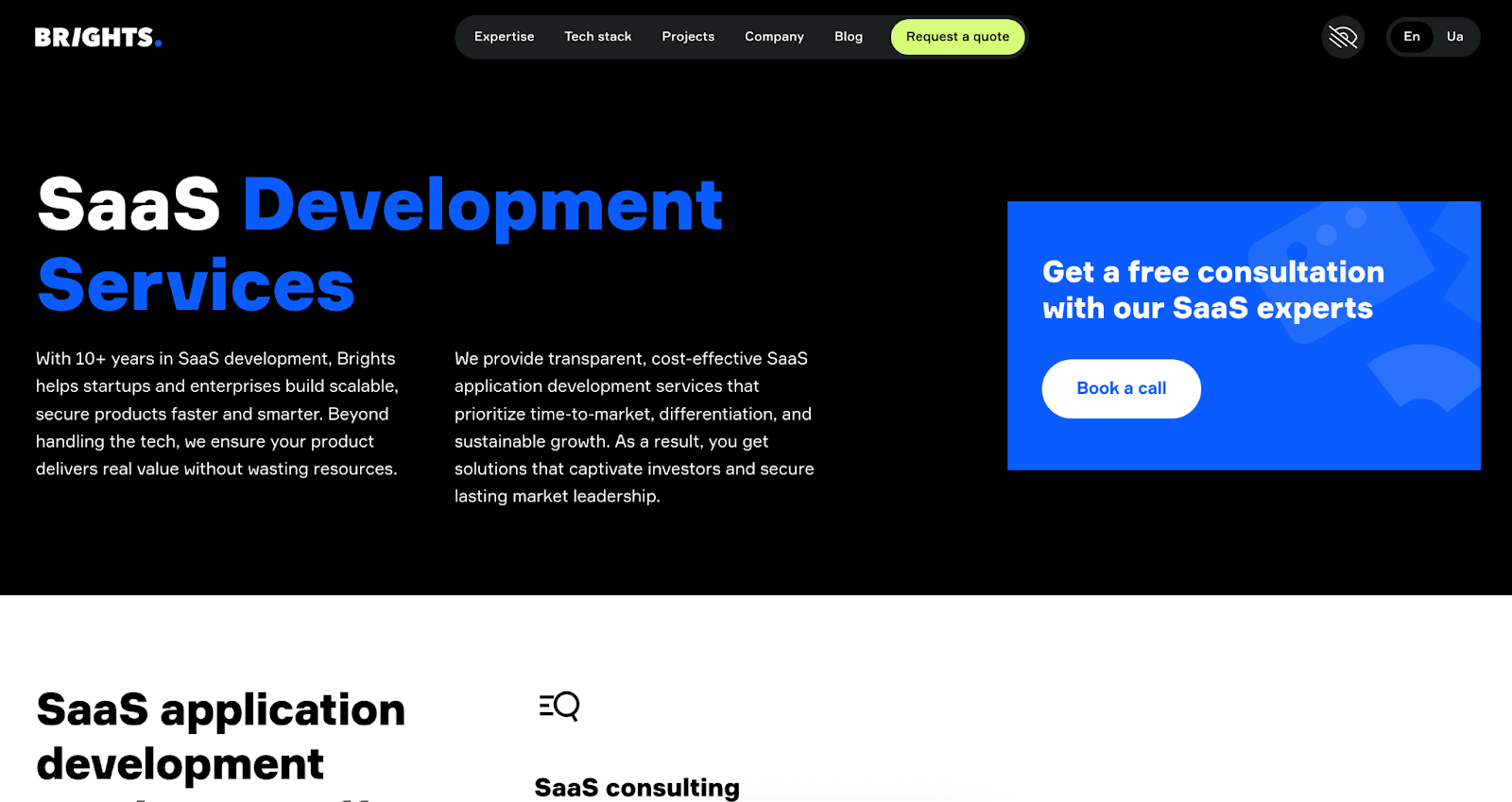
This Ukrainian company takes a practical approach to AI integration, prioritizing measurable business outcomes over hype. This SaaS development company has mastered the critical balance between velocity and architectural integrity, embedding AI capabilities from day one rather than retrofitting them as afterthoughts. Their portfolio spans fintech fraud detection and healthtech diagnostic solutions using computer vision.
Core capabilities:
- Scalable data pipelines with Apache Kafka and Apache Flink
- MLOps automation through MLflow and Kubeflow
- Custom infrastructure for peak-load stability
Their retail demand forecasting platform processes data from thousands of sales points, weighing over 200 factors from weather to local events. The system hits 92% forecast accuracy, cutting client inventory costs by 34%. Many AI projects collapse from poor data handling rather than weak algorithms – Brights addresses this through robust pipeline architecture.
2. Intellectsoft
This American-Ukrainian firm targets enterprise clients with complex AI systems. Their Harley-Davidson collaboration produced a platform analyzing motorcyclist behavior through IoT sensors, delivering personalized maintenance recommendations.
Key achievements:
- R&D focus on reinforcement learning and generative AI
- Legal AI assistant analyzing case law and drafting documents
- Synthetic data generation for privacy-compliant training
Their legal assistant trained on millions of court decisions understands legal context beyond standard search capabilities. The synthetic data work proves critical for healthcare and finance projects where regulations restrict real data use.
3. ELEKS
ELEKS concentrates on computer vision and NLP solutions. Their manufacturing quality control platform uses deep learning for defect detection on assembly lines, achieving 99.7% accuracy and saving millions in defective products.
Specialized work:
- Multilingual sentiment analysis across 30+ languages
- Automotive edge AI with sub-50ms latency
- Culture-aware NLP models
Their automotive system performs object recognition on vehicle computers directly, meeting safety requirements through minimal latency. The multilingual sentiment tool handles cultural nuances and idioms that trip up generic NLP models.
4. Simform
Simform accelerates startup MVP development through pre-trained models and transfer learning, compressing timelines from 12 months to 3-4 months.
Development focus:
- Prompt engineering and LLM fine-tuning
- Custom A/B testing for production AI models
- Business KPI optimization over technical metrics
Their e-commerce AI assistants conduct product dialogues considering purchase history and preferences. The A/B testing framework routes traffic between model versions, measuring business outcomes rather than just accuracy scores.
5. DataRoot Labs
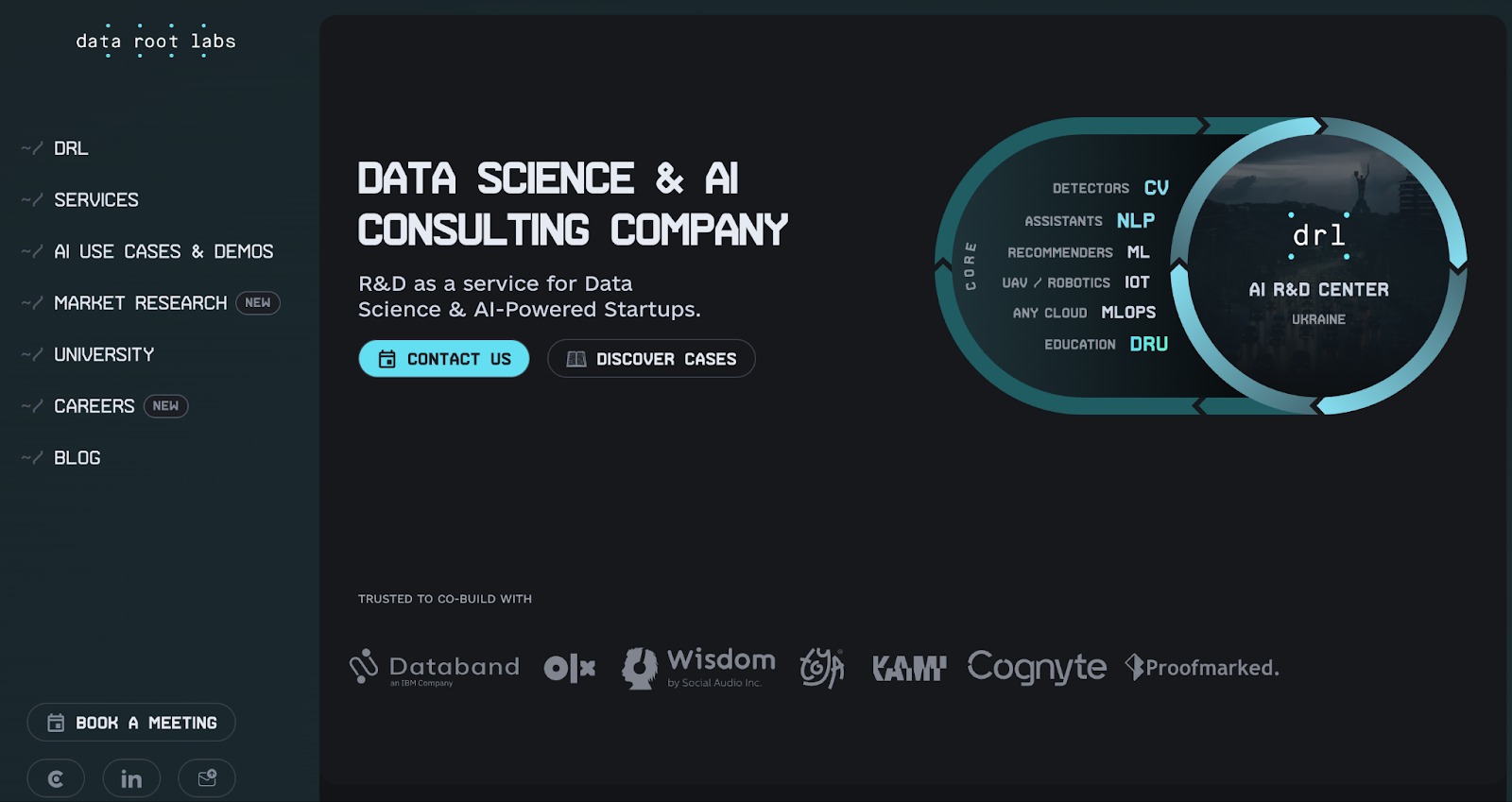
DataRoot Labs merges data science with software engineering. Their pharmaceutical platform analyzes millions of molecular structures to predict drug effectiveness, compressing research timelines from years to months.
Technical strengths:
- Tabular data processing with gradient boosting
- Ensemble methods outperforming neural networks on structured data
- Energy sector time series forecasting
Their energy forecasting system considers weather patterns, historical trends, and social events, enabling procurement optimization worth millions annually. The tabular data expertise addresses the most common business data type through XGBoost, LightGBM, and CatBoost implementations.
6. Iflexion
Iflexion builds custom enterprise platforms rather than selling packaged solutions. Their logistics AI manages thousands of daily shipments for international operations.
Enterprise capabilities:
- Reinforcement learning for dynamic route optimization
- 18% faster deliveries with 12% lower fuel costs
- Real-time fraud detection for financial institutions
The routing system learns from historical data and simulations, weighing traffic, weather, customs, and priorities. Their banking anomaly detection analyzes behavioral patterns beyond transaction amounts, catching sophisticated fraud schemes.
7. ScienceSoft
ScienceSoft’s 35 years in IT inform their systematic AI implementation approach. Their methodology starts with readiness assessment, often revealing data quality or organizational issues requiring attention before AI deployment.
Structured approach:
- Pre-project AI readiness evaluation
- Predictive maintenance cutting downtime 40%
- Document intelligence exceeding 95% accuracy
Their manufacturing platform uses LSTM networks and anomaly detection on IoT sensor data, predicting equipment failures weeks ahead. This reduced client downtime by 40% and repair costs by 25%. The insurance document intelligence system processes claims forms, extracting structured data and classifying by type, shrinking processing from days to hours.
8. Webisoft
Webisoft develops conversational AI beyond simple bots. Their systems use advanced NLP and retrieval-augmented generation for complex multi-turn dialogues.
Conversational solutions:
- RAG-powered assistants for nuanced conversations
- Adaptive learning systems boosting student scores 30%
- Multi-dialect voice AI for noisy environments
Their e-learning AI adapts learning paths based on student progress and style, identifying difficult topics and suggesting alternatives. Students using the assistant score 30% higher on tests. Voice AI implementations handle noisy settings and accent variations for smart home and automotive applications.
9. Oxagile
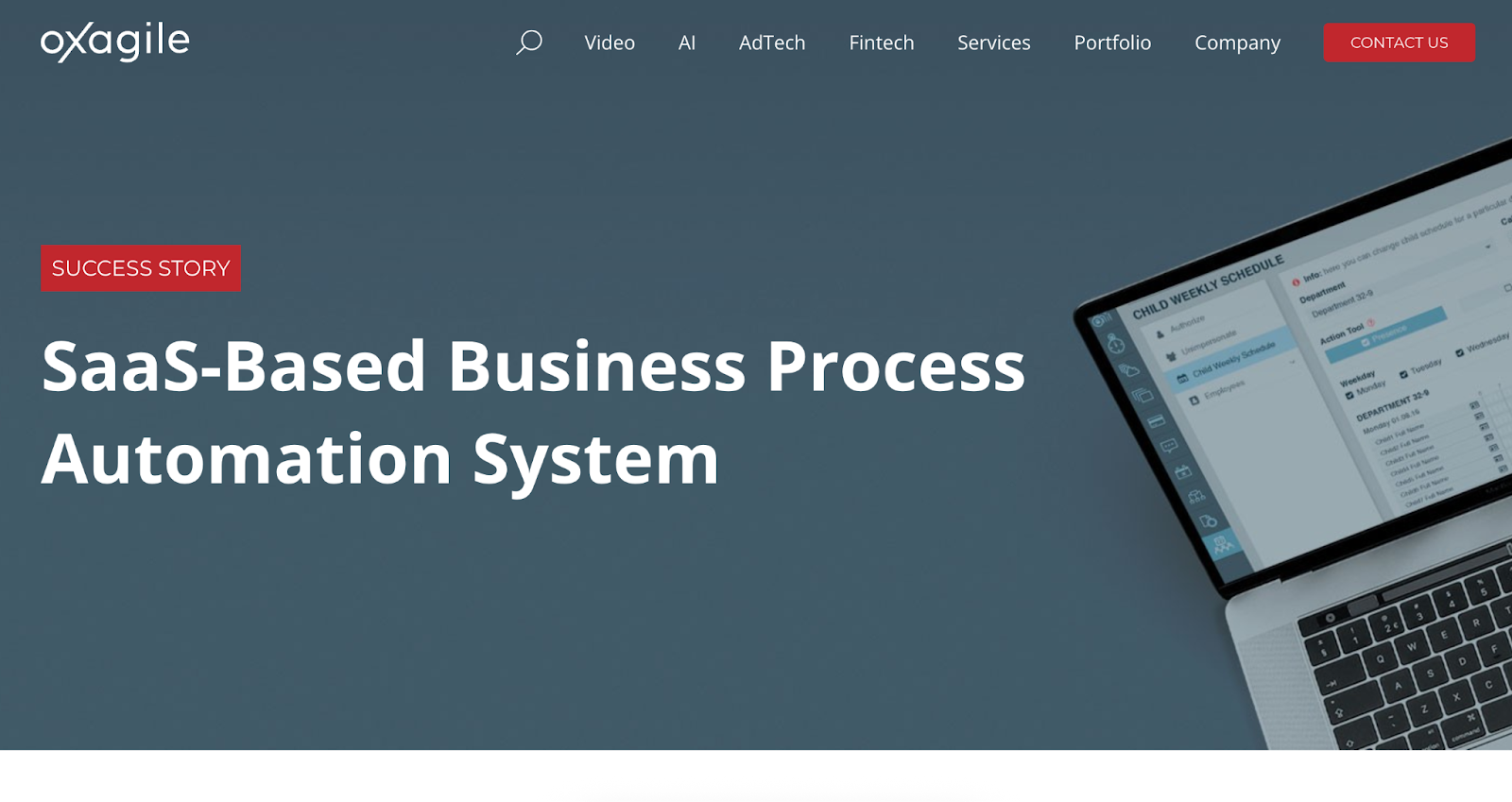
Oxagile specializes in video analytics and AI-enabled streaming. Their sports broadcasting system generates highlights automatically through computer vision identifying key moments.
Video expertise:
- Automated highlight generation from sports footage
- Multimodal content moderation with cultural awareness
- Personalization engines lifting click-through 45%
The content moderation tool analyzes images, video, and text faster and more accurately than human teams while understanding cultural context. Their streaming personalization combines collaborative filtering with content-based methods and contextual factors like time and device, achieving 45% higher click-through rates.
10. Daffodil Software
Daffodil combines AI expertise with industry-specific knowledge. Their agricultural projects use satellite imagery and computer vision for crop monitoring, helping farmers optimize irrigation and predict yields.
Industry applications:
- Satellite-based agricultural monitoring and prediction
- Radiologist AI assistant raising diagnostic accuracy 12%
- Hybrid retail recommenders with continuous learning
Their healthcare AI serves as a second opinion tool for radiologists, flagging potential issues in medical images. Clinical trials demonstrated 12% accuracy improvements. The retail recommendation system blends collaborative filtering, content methods, and contextual bandits, learning continuously from feedback and tests.
Selection Criteria for AI Partners
Technical skills alone don’t guarantee success. Industry experience matters – fintech AI developers may lack healthcare knowledge around privacy and FDA processes. Cost and timeline transparency separates solid partners from overpromising vendors. AI projects carry more uncertainty than traditional development. Reliable firms discuss risks openly, propose phased approaches with milestones, and avoid guaranteeing impossible results.
Cultural fit affects productivity. Communication styles, workflows, and time zones all matter for AI projects requiring close collaboration. Eastern European companies often balance cost, quality, and cultural alignment for Western clients.
Portfolio case studies reveal practical experience. Look beyond technology lists to business results. Did the AI improve key metrics measurably? Did the solution reach production scale? Does the client still use the system a year later?
Conclusions
Choosing an AI-driven SaaS partner shapes business trajectory in ways obvious only in hindsight. Each company brings distinct advantages: Intellectsoft’s enterprise reach, Simform’s startup agility, Daffodil’s domain depth, Brights’ technical rigor. The right choice depends on requirements, budget, and objectives – but also on whether their engineers challenge your assumptions and whether project managers tell you when you’re asking for something that won’t work.
Markets evolve rapidly. GPT-4 seemed revolutionary in 2023; by 2025, it was a commodity. Foundation models like Claude Sonnet 4.5 and GPT-4o democratize AI access, but value creation demands domain understanding, quality data, sound architecture, and ongoing optimization. The companies thriving in 2026 won’t be those with the biggest models – they’ll be those with the smartest implementation.
Successful projects start with clear problem definition. Technology serves as the tool, not the goal. Strong partners help set realistic goals, validate hypotheses through MVPs, and scale to enterprise deployment. They’ll tell you when your data isn’t ready, when a rule-based system makes more sense than machine learning, and when the EU AI Act means you need human oversight.
The 2026 question isn’t whether to use AI in SaaS products. It’s how to implement it effectively, responsibly, and in ways that survive contact with real users. Choose partners who understand that difference.

