


The Shift: From Search Engines to AI Conversations
User behavior is undergoing a fundamental transformation. Instead of typing short keywords into Google, people now ask conversational questions to AI systems like ChatGPT, Perplexity, Google AI Overviews, Claude, and Gemini. ChatGPT alone processes approximately 2 billion queries daily and has become the 4th most visited website globally . Meanwhile, Perplexity saw a staggering 500%+ surge in usage during 2024, signaling growing appetite for AI-native search experiences .
This shift has tangible consequences. About 36% of generative AI users report replacing traditional search with AI assistants for some queries . In specialized niches like programming, an estimated 30% of searches now happen on ChatGPT rather than Google . ChatGPT holds an 81% AI chatbot market share, with 32% of interactions being informational and 9% commercial—highlighting its growing role in product discovery and purchase decisions .
The critical implication for brands: AI search engines send on average 96% less referral traffic than Google for comparable queries . Users increasingly get their answers directly from AI summaries without clicking through to source websites. This means brands can no longer rely solely on traditional SEO rankings—they must compete to be mentioned, recommended, cited, and positively positioned inside AI-generated responses .
How AI Search Differs from Traditional Search
Traditional search engines return ranked lists of links. Users click through to websites, and brands optimize for keyword rankings, click-through rates, and organic traffic. AI-powered systems work fundamentally differently :
- Users ask natural-language questions like “What’s the best CRM for a mid-size company?” rather than typing “best CRM mid-size”
- AI models respond with opinions, summaries, comparisons, and recommendations—often without links, rankings, or transparency
- LLMs perform internal web searches as part of their reasoning, breaking user questions into multiple implicit queries that shape which sources get cited
- Answers vary by persona, geography, and language—the same question produces different recommendations when asked by a startup founder versus an enterprise decision-maker
- Multi-turn conversations mean brand perception evolves across dialogue turns; a brand may enter or exit consideration as users add constraints
The Generative Engine Optimization (GEO) services market reflects this shift: valued at $886 million in 2024, it is projected to reach $7.3 billion by 2031, growing at a 34% CAGR .
The New Questions Brands Must Answer
Traditional SEO tools answer “Where do I rank on Google?” and “How much traffic do I get?” But the new search paradigm demands entirely different questions :
- Is my brand mentioned at all in AI answers?
- In what scenarios does AI recommend me?
- Who are my real competitors in AI conversations?
- What does AI say about my strengths and weaknesses?
- Which sources does AI use to talk about me?
- How do I increase my share of voice inside AI responses?
A new category of AI visibility tools has emerged to answer these questions, giving rise to GEO as the next generation of SEO .
Genezio: Deep Dive from the Attached Document
Genezio is an AI Visibility platform designed to help brands understand, measure, and improve how they appear inside AI-powered answers across ChatGPT, Perplexity, Google AI Overviews, Claude, and other LLM-based systems .
Core Architecture
Genezio runs structured, multi-turn conversations against multiple LLMs and analyzes their responses. What sets it apart is its execution approach: by default, it interacts with LLMs through their real web interfaces—the same interfaces used by actual users—rather than relying solely on APIs . This distinction matters because LLM behavior differs significantly between API usage and web-based usage: wording, recommendations, citation behavior, and ranking logic are not identical . This approach is also used by Peec AI, which similarly employs UI scraping rather than API polling .
Key Differentiating Capabilities
Genezio introduces several unique concepts documented in the attached analysis :
- Persona-driven analysis: Conversations are always evaluated through realistic customer profiles (role, seniority, company size, language, geography), because LLMs respond very differently depending on who is asking
- Multi-turn conversations: Instead of isolated prompts, Genezio models entire conversational flows where follow-up questions, budget constraints, and existing tools can shift recommendations entirely
- Automatic competitor discovery: Competitors are derived from AI conversations rather than defined manually, often revealing unexpected competitors that dominate AI recommendations despite low traditional SEO visibility
- LLM keyword extraction: Genezio surfaces the actual internal search queries LLMs use during conversations—queries invisible to users but directly shaping which sources get cited
- Statement traceability: Every factual claim an LLM makes about a brand is extracted, tracked, and traced back to the conversations, personas, keywords, and citations that support it
- Citation sentiment analysis: Citations are grouped by domain (first-party vs. third-party) with sentiment analysis revealing whether sources describe the brand positively or negatively
- Geography-aware execution: Conversations run as if originating from specific countries, triggering location-specific ranking, citation, and recommendation logic
Pricing
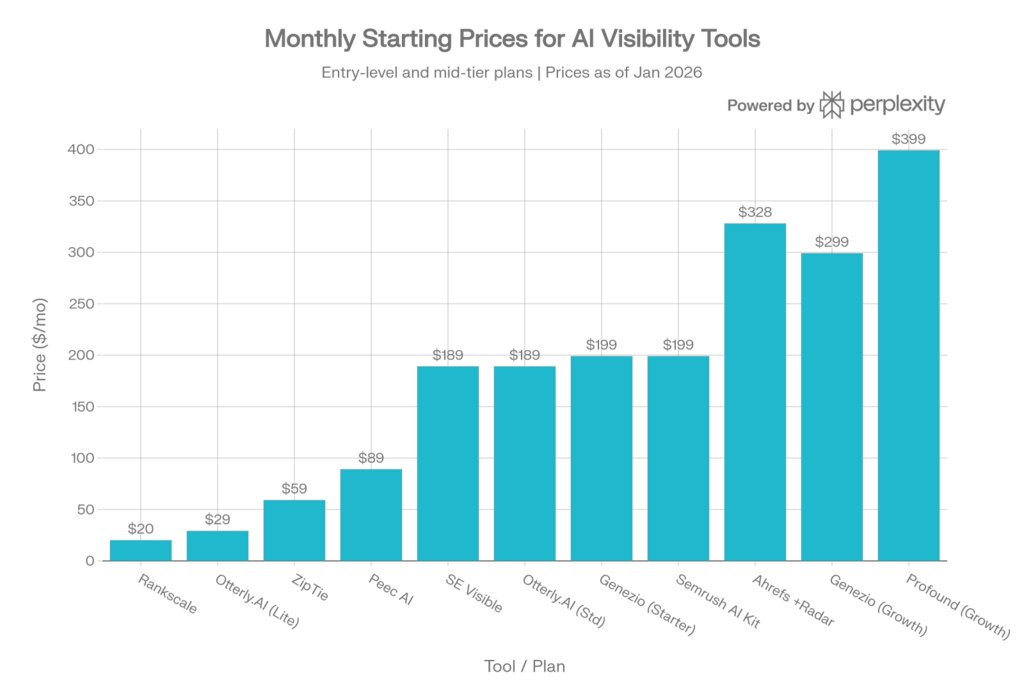
Genezio offers three tiers :
| Plan | Price | LLMs | Scenarios | Key Features |
| Starter | €199/mo | 2 | 50 | Daily insights, 1 month retention |
| Growth | €299/mo | 4 | 50 | Multi-turn, content gen, 6 months retention |
| Enterprise | Custom | 10 | Custom | Unlimited retention, SSO, dedicated support |
Competitive Landscape: AI Visibility Tools Compared
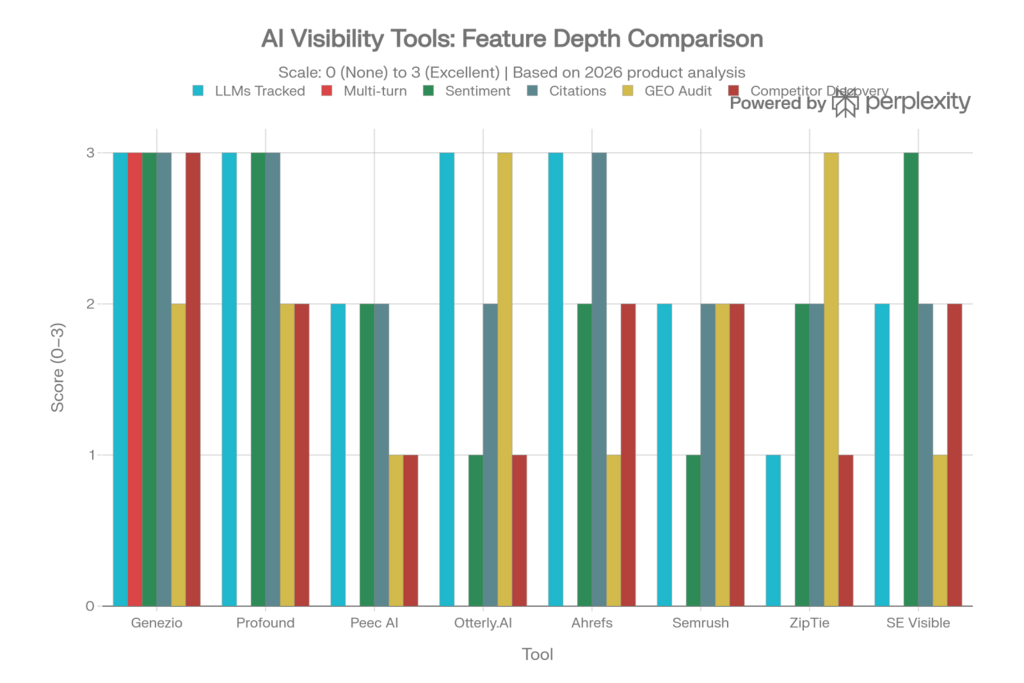
The AI visibility market has rapidly expanded with tools ranging from affordable trackers to enterprise-grade platforms . Below is a comparison of the most prominent solutions alongside Genezio.
Tool-by-Tool Analysis
| Tool | Best For | AI Platforms Tracked | Starting Price | Unique Strength |
| Genezio | Multi-turn, persona-driven analysis | ChatGPT, Perplexity, Google AIO, Claude, Gemini + more | €199/mo | Real web UI scraping, multi-turn conversations, statement traceability |
| Profound | Enterprise all-in-one needs | ChatGPT, Perplexity, Google AIO/Mode, Copilot, Gemini, Claude, Meta AI, Grok, DeepSeek | $82.50/mo (annual) | CDN integration, content generation, Conversation Explorer with 180M+ prompts |
| Peec AI | Clean UX, agency pitches | ChatGPT, Google AIO, Perplexity (+ add-ons for Claude, Gemini, DeepSeek) | €89/mo | Pitch Workspaces, unlimited seats on Starter, Looker Studio connector |
| Otterly.AI | Affordable GEO audits | ChatGPT, Perplexity, Google AIO/Mode, Copilot, Gemini | $29/mo (Lite) | Deep GEO audit with 25+ technical/content factors, location-focused |
| Ahrefs Brand Radar | Benchmarking at scale | ChatGPT, Google AIO/Mode, Claude, Gemini, Perplexity, Copilot | $129/mo (with Ahrefs) | Massive AI index (100M+ prompts), multi-channel monitoring incl. Reddit/YouTube |
| Semrush AI Toolkit | Existing Semrush users | ChatGPT, Google AI, Gemini, Perplexity | $99/mo add-on | 180M+ prompt database, integrated with full SEO/PPC suite |
| ZipTie | Deep analysis and reporting | Google AIO, ChatGPT, Perplexity | $58.65/mo (annual) | AI Success Score, URL-level filtering, content optimization tool |
| SE Visible | Strategic brand overview | ChatGPT, Perplexity, AI Mode, Gemini | $189/mo | Clear sentiment scoring, prompt insights, inherited SE Ranking data accuracy |
Key Differentiators Across Tools
Conversation depth: Genezio is unique in supporting true multi-turn, persona-driven conversations that simulate entire buying journeys . Most competitors (Profound, Peec, Otterly, Ahrefs) track single-prompt responses. Zapier’s evaluation notes that “understanding the full context of how users interact with AI engines—including follow-up questions, conversation flow—provides deeper insights than simply tracking final outputs” .
Data collection method: Genezio and Peec AI use real web interface scraping rather than API-only approaches, producing results closer to what actual users see . Profound and ZipTie also employ methods mimicking real user behavior . API-based tools may miss differences in wording, citation selection, and recommendation logic that appear in production interfaces .
Content optimization: Profound and ZipTie include built-in content generation and optimization tools . Semrush integrates with its broader content suite . Otterly.AI excels at technical GEO audits with 25+ factors analyzed . Genezio provides AI content generation (coming soon on Growth plan) and actionable insights linking keywords to citations to statements .
Competitor intelligence: Genezio automatically discovers competitors from AI conversations rather than requiring manual input, often revealing brands that dominate AI recommendations despite low traditional SEO visibility . Ahrefs and SE Visible offer competitive benchmarking against tracked competitors . Profound provides detailed competitive sentiment analysis .
Geographic and persona targeting: Genezio explicitly models language, geography, and persona differences, running conversations as if they originate from specific countries with specific user profiles . Peec AI offers multi-region tracking across 80+ countries from entry tier . Writesonic GEO simulates queries from different locations .
Strategic Recommendations
For brands evaluating AI visibility tools, the choice depends on organizational needs:
- Enterprise brands needing deep conversational analysis: Genezio’s multi-turn, persona-driven approach provides the most realistic simulation of how AI actually forms opinions about brands
- Large enterprises with CDN infrastructure: Profound offers the broadest engine coverage and CDN traffic integration to connect AI crawler activity to real site visits
- Agencies and teams on a budget: Otterly.AI ($29/mo) and Peec AI (€89/mo) provide cost-effective entry points with solid feature sets
- Teams already in the Ahrefs/Semrush ecosystem: Brand Radar and the Semrush AI Toolkit add AI visibility without switching platforms
- Content-focused teams: ZipTie and Clearscope excel at translating visibility data into specific content optimization actions
The AI visibility space is evolving rapidly—new features are being added monthly across all platforms. No single tool currently addresses every need, and many organizations may benefit from combining a monitoring-focused tool with a content optimization platform . The key is to start measuring now: as AI conversations increasingly replace traditional search, brands that understand and optimize their AI presence will have a decisive advantage over those still focused exclusively on Google rankings .

