


It’s never been easier to launch a website, but it’s also never been harder to stand out.
Most businesses focus on SEO and call it a day. But search rankings are just one piece of the digital visibility puzzle. If your site is hard to use, inaccessible, or poorly structured, all the traffic in the world won’t help.
At Composite Global, we help brands optimize their websites from every angle. This guide walks you through the seven essential pillars of online presence, with actionable tips for each.
1. UX: User Experience
If users can’t find what they need, they won’t stick around.
User Experience (UX) is about making your site clear, intuitive, and easy to use. That includes:
- A clear visual hierarchy
- Logical page structure and navigation
- Consistent CTAs (calls to action)
- Mobile responsiveness
- Fast load times
Ask yourself: Can a first-time visitor figure out what your business does, what they should do next, and how to trust you?
Pro Tip: Use tools like Hotjar or Microsoft Clarity to spot friction points in real user behavior.
This screenshop of Composite’s heatmap from Microsoft Clarity provides insight into where users click and focus.
2. AX: Agent Experience
With the rise of ChatGPT, Perplexity, and SGE, AI is the new front door to your website.
AX, or Agent Experience, introduces a new layer of UX focused on making your content and structure easy for AI agents to parse, summarize, and recommend. These tools don’t scroll through your site like a human. They rely on clean, semantic data to understand what your business does and who it serves.
To improve AX:
- Use semantic HTML (headings, lists, articles)
- Write clearly and avoid vague jargon
- Add internal links to build context
- Use llms.txt to guide large language models to your most valuable pages
Read more about designing for AI.
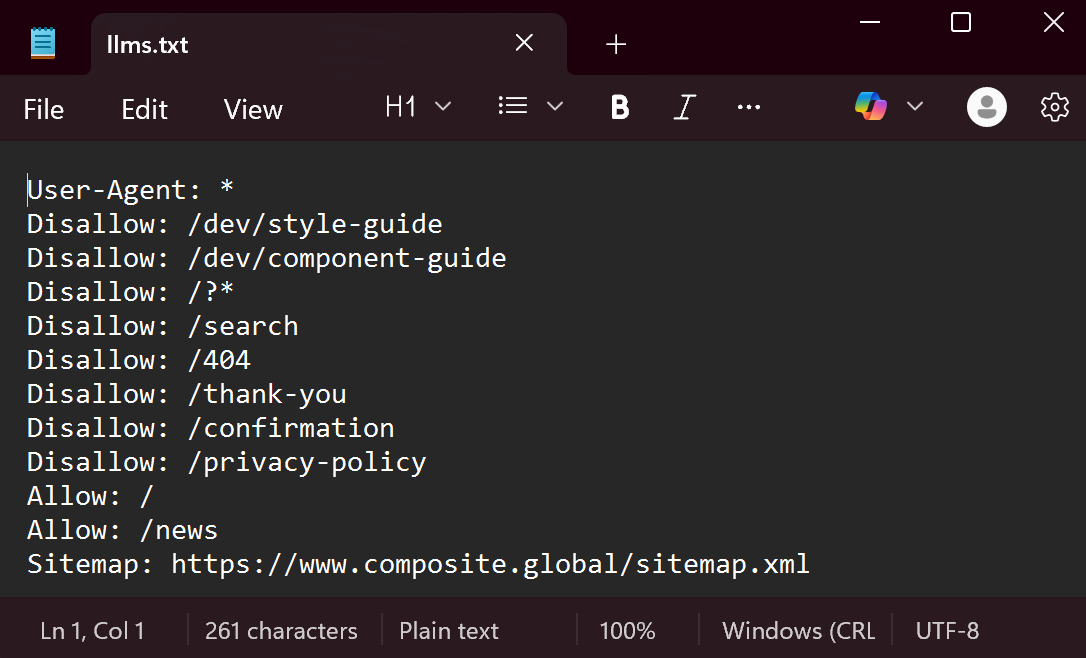
Composite’s llms.txt file disallows internal pages used by our dev team (like style guides and 404 pages), while explicitly allowing our News page so LLMs can prioritize and understand our blog content.
3. SEO: Search Engine Optimization
Search still matters, but modern SEO is about structure, content quality, and trust signals, not keyword stuffing.
Focus on:
- Clear page titles and meta descriptions
- Descriptive URLs
- Fast, mobile-first performance
- Structured data (schema markup)
- A helpful, people-first content strategy (focusing on creating truly valuable content first is better than starting with keywords)
- Use robots.txt files to help search engines understand your content
Also: make sure your sitemap is submitted in Google Search Console and that all important pages are indexed.
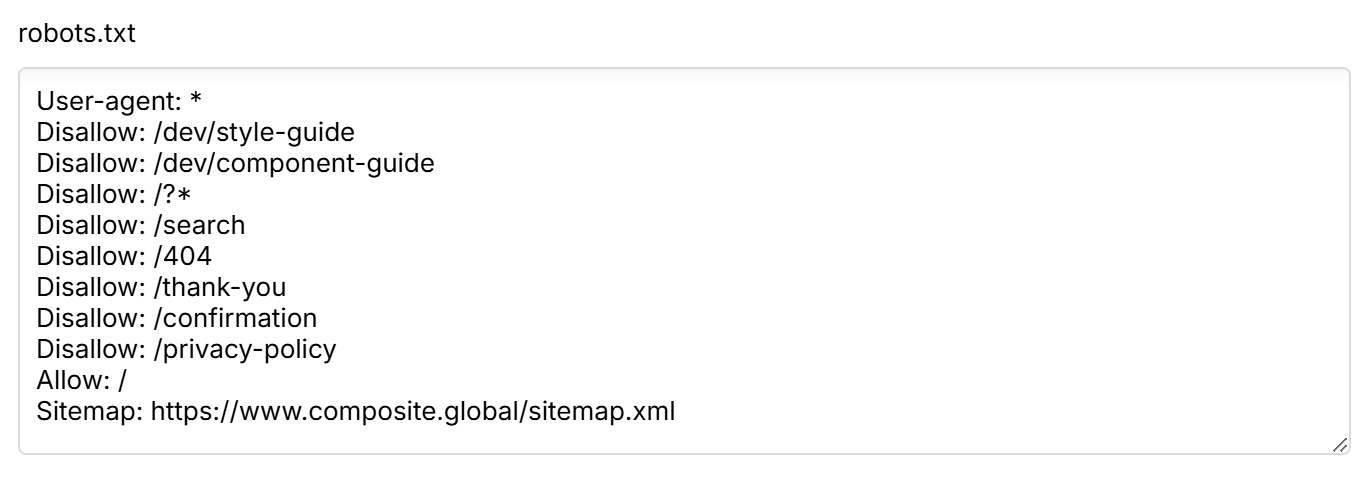
Composite’s robots.txt file disallows internal pages used by our dev team (like style guides and 404 pages).
4. SMO: Social Media Optimization
Social traffic may not convert immediately, but it builds brand visibility and trust.
SMO means:
- Optimizing content for shareability (strong visuals, bite-sized tips, value-driven headlines)
- Using consistent branding and tone across platforms
- Embedding social proof (testimonials, press, UGC) on your site
- Tracking UTM parameters to measure results
If your content lives only on your site, you’re missing a huge slice of the attention economy.
5. Accessibility
Accessibility is often overlooked, but it’s a competitive advantage, and an inclusive need.
An accessible site:
- Reaches more users
- Builds trust and credibility
- Improves SEO and AX signals
- Keeps you compliant with legal standards
- Ensures all users can interact with your content
Key best practices:
- Use semantic HTML and ARIA labels
- Provide descriptive alt text for images
- Ensure color contrast meets WCAG standards
- Avoid motion that can’t be paused or controlled
See more on how accessibility overlaps with AI optimization.
6. DA: Domain Authority
Domain Authority (DA) is a score developed by Moz to predict how well your site will rank on search engines. It’s influenced by:
- Quality backlinks
- Content consistency
- Site age and trust signals
- Technical health
Ways to improve DA:
- Earn backlinks from relevant, trusted sites
- Publish high-quality, linkable content
- Avoid broken links and spammy redirects
- Build topic authority over time
Remember: DA isn’t a Google metric, but it’s a strong proxy for credibility. Improving your DA takes time, be patient and trust the process.
7. Site Health
Even a great design can fall apart if the backend is broken.
Use tools like Google Search Console, Ahrefs, or Sitebulb to check for:
- Broken links and 404 errors
- Duplicate content
- Redirect loops
- Slow page load speeds
- Security issues (SSL, outdated plugins, etc.)
Schedule monthly check-ins to catch issues before they impact SEO, performance, or trust.
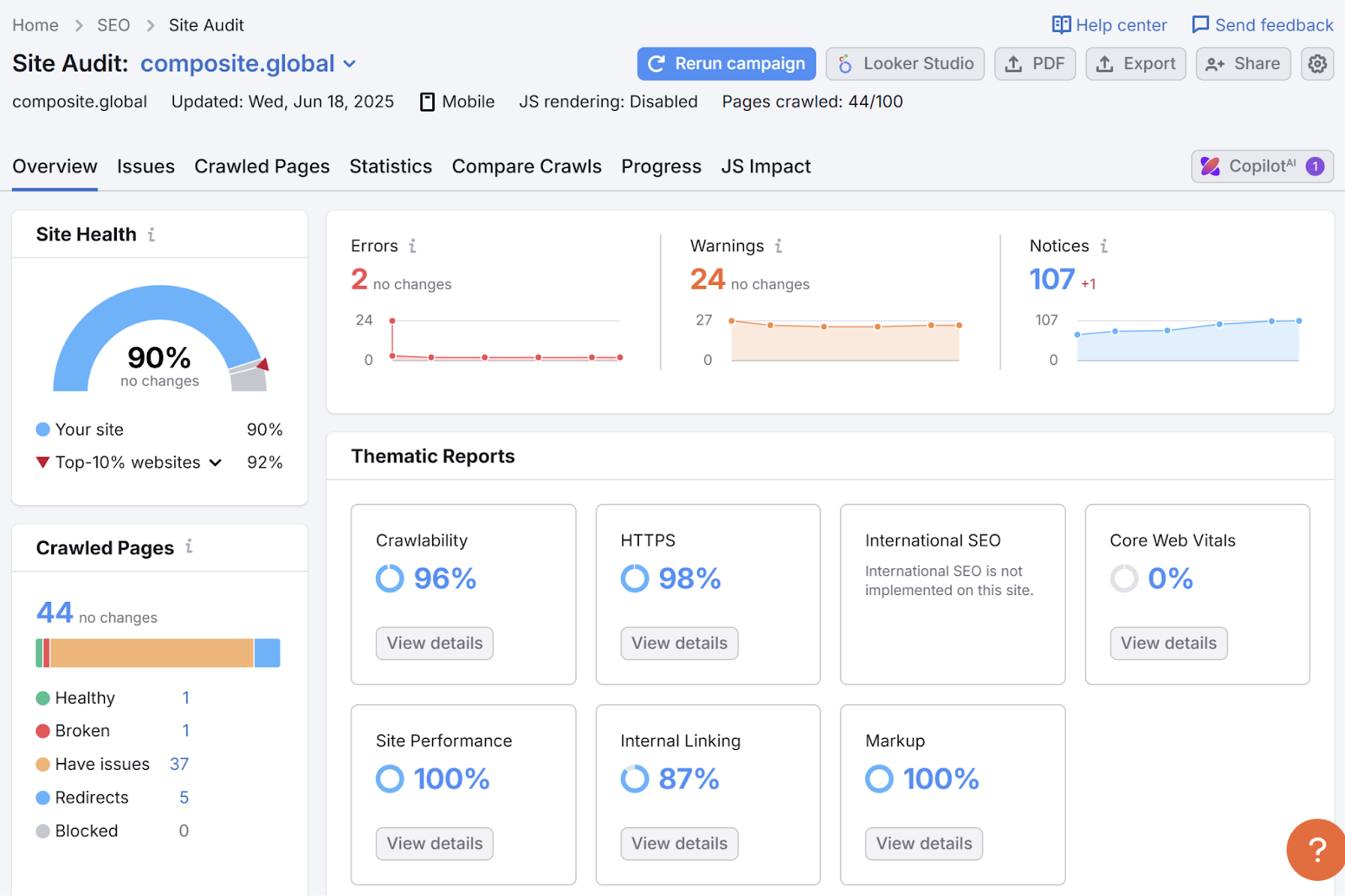
Composite’s Site Audit from Semrush shows our site health—a metric we work towards improving consistently.
Final Thoughts: Optimize Holistically, Not in Silos
You don’t need to master all seven pillars at once, but ignoring any one of them will hold your brand back.
Think of your website as a system:
- UX makes it usable to people
- AX makes it usable to machines
- SEO and SMO drive traffic
- Accessibility and site health build trust and visibility
- DA amplifies your visibility
Small improvements in each area compound over time and help your digital presence work smarter, not just harder.

