


When you’re running a small ecommerce business, getting today’s orders out the door usually feels more important than documenting how the work gets done. Orders come in, labels are printed, messages pile up and product ideas are scribbled on sticky notes. With so much to do, many founders decide they will document their process “later.” They worry that writing down steps will make them feel corporate or slow them down. But documentation isn’t paperwork for the sake of it. It’s a simple tool that protects customer trust, reduces mistakes and frees up time.
Good documentation can be the difference between a loyal customer and a bad review. Research from the Baymard Institute shows that around 70% of online shoppers abandon their cart , and one reason is friction during checkout . If your internal process is unclear, the friction you feel behind the scenes eventually shows up on your customer’s screen. This article explains why documenting your workflows is crucial for small ecommerce brands and how to start.
Why Small Brands Avoid Documentation
Many founders keep their processes in their head. It seems faster to just do the work rather than stop and write down each step. Small business owners also face real resource constraints: supply chain disruptions, rising health benefit costs and salaries are some of their top operational challenges . When time is limited, documentation feels like a luxury.
Another reason documentation gets ignored is that it feels too formal. You may think standard operating procedures (SOPs) are for large corporations with whole departments. In reality, simple checklists work well for small teams. You don’t need a thick binder; you need clarity. Ignoring documentation creates hidden risks that surface when orders pile up or when you hire your first employee.
The Hidden Cost of “I’ll Just Remember”
Small ecommerce teams often handle everything from product creation to shipping. When details remain only in the founder’s head, mistakes happen. Here are a few examples:
- Shipping mistakes: Wrong sizes, missing items or incorrect addresses cost money and hurt credibility.
- Missed customer notes: Gift messages or special instructions can be overlooked when there is no consistent place to capture them.
- Inconsistent packaging: Some orders arrive with tissue paper and branded inserts while others look thrown together.
- Delayed replies: Without a template, support replies take longer and may miss important details.
- Inventory confusion: Without a clear process, you might oversell popular items or forget to reorder slower moving stock.
- Training problems: New team members have to shadow the founder for everything, leading to inconsistent outcomes.
The Baymard Institute found that about 17% of U.S. shoppers abandon an order because the checkout process is too long or complicated . If your internal process is messy, creating an efficient checkout becomes difficult. Improving usability can increase conversion rates by roughly 35% . Documentation reduces friction behind the scenes so customers feel a smooth experience.
The First Processes Worth Documenting
Not every task needs a formal SOP, but certain processes should be documented early. Start with activities that repeat daily or impact the customer directly.
- Order review: Outline how you verify payment, check for duplicate orders and confirm the right product variant.
- Address verification: Note how you catch typos or missing apartment numbers before printing labels.
- Packaging steps: List what goes in each package, including inserts, labels, and how products should be arranged.
- Shipping label creation: Describe which platform you use, how to select carrier services and how to manage international customs forms.
- Tracking updates: Decide when to send the tracking number and how to communicate delays.
- Refunds and returns: Define when to offer returns, how to process refunds and where returned items go in your system.
- Customer support replies: Keep a library of friendly templates for common questions. Avoid jargon and use plain language.
- Product quality checks: Include steps for checking printing, packaging and labeling before shipping.
- Inventory reorder points: Document how you monitor stock levels, set reorder thresholds and choose suppliers.
Starting with these core processes will protect your brand’s reputation. Detailed SOPs help ensure that each order receives the same care, whether you have one or ten people working with you.
How Documentation Protects Customer Trust
Customers do not see your warehouse or your computer screen. They judge your brand by the speed and accuracy of delivery, the packaging and the service you provide. A clear process helps you achieve consistency. When every box is packed the same way and every email uses the same tone, customers know what to expect.
Documentation also makes it easier to improve your service. You can identify which steps cause delays or mistakes and adjust them. The Baymard Institute notes that simplifying checkout flows by reducing form fields can dramatically improve conversion . The same principle applies to your workflows: remove unnecessary steps and clarify the remaining ones. This reduces friction for your team and your customers.
A Simple Example From a Niche Ecommerce Brand
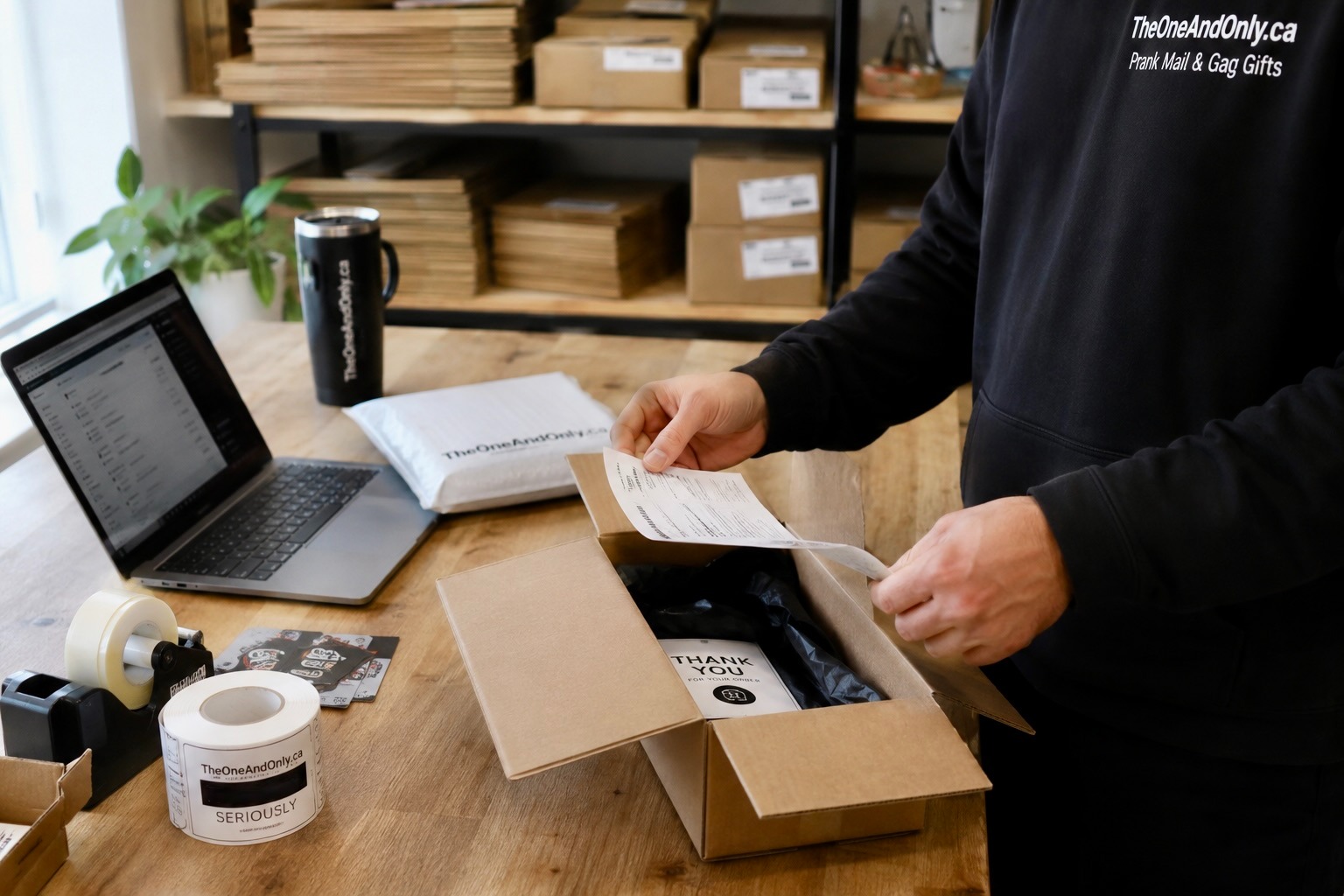
Consider TheOneAndOnly.ca, a Canadian ecommerce brand that sells prank mail, gag gifts, novelty stickers and The Puck Drop™. The store promises anonymous delivery and no invoice inside the package. To meet this promise, the team created a short SOP:
- Verify anonymity: Double check that the sender’s name is not printed on the shipping label.
- Remove invoice: Confirm that no receipt or invoice slips into the package.
- Address check: Cross check the recipient’s address against the order to ensure there are no typos.
- Package presentation: Make sure the product is centered and any branding looks deliberate.
This simple four step document prevents embarrassing mistakes. Without it, a new staff member might slip in a packing slip or print the wrong name. The SOP protects customer expectations while requiring little time to maintain. Notice that the brand itself is not the subject of the article. It is used only as an example of why documentation matters.
How AI Can Help Without Replacing Judgment
Artificial intelligence tools can assist in turning rough notes into a first draft. For example, an AI writing assistant can transcribe a founder’s spoken explanation of a process into a draft SOP. AI can summarise chat logs, organise bullet lists or suggest a structure for standard responses. However, AI cannot replace human judgment. A Forbes piece on professional responsibility reminds us that while AI may speed up work, competence, due diligence and human review are still required. Generative AI can make professionals more efficient but it cannot substitute for human judgment.
Use AI to handle repetitive tasks like drafting checklists or organising scattered notes. Then review the output yourself to ensure it reflects your brand and accounts for edge cases. Documenting your processes doesn’t mean outsourcing your expertise. It means capturing it in a format that others can follow.
The Best SOPs Are Simple
Standard operating procedures are only useful if people actually use them. According to a guide on writing SOPs, if instructions are too complicated they confuse people and risk mistakes . Good SOPs should be detailed enough to train new employees but clear enough for existing team members to follow quickly. Here’s what to include:
- When to use it: Define the situation that triggers this process (e.g., when an order is placed).
- Who owns it: Assign responsibility so everyone knows who should carry out or review the task.
- Required tools: List the software, hardware or supplies needed.
- Step by step actions: Use numbered steps or bullet points. Keep sentences short and avoid abbreviations unless explained.
- Quality checks: Add checkpoints to verify accuracy (e.g., confirm the shipping address before printing).
- Common mistakes: Note frequent pitfalls to watch for.
- What to do when something goes wrong: Provide guidance for exceptions or when a step cannot be completed.
When SOPs are clear, training becomes easier. New team members can learn without shadowing for days. Even if you’re the only person in the business, having these documents means you can take a break without worrying that orders will be packed incorrectly.
Start Before It Feels Urgent
The right time to create documentation is before you desperately need it. If you wait until the holiday rush or until you hire your first employee, you’ll be documenting under pressure. Documentation gives you confidence to scale. It ensures that when sales spike, each order still meets your standard.
Start small. Write down one process per day or record yourself completing a task and transcribe it later. You do not need to create all your SOPs at once. Begin with the tasks that impact customers the most and expand from there. Over time, your documents will mature and improve. Remember that the cost of not documenting your processes usually shows up later as lost trust or frantic corrections.
Quick Takeaway
- Documentation protects customer trust by ensuring consistency across orders.
- Keeping processes in your head leads to mistakes, delays and training problems.
- Start with core processes like order review, packaging and customer support.
- Use AI tools to draft SOPs but always review them yourself .
- Simple, clear procedures help even small teams scale without chaos.
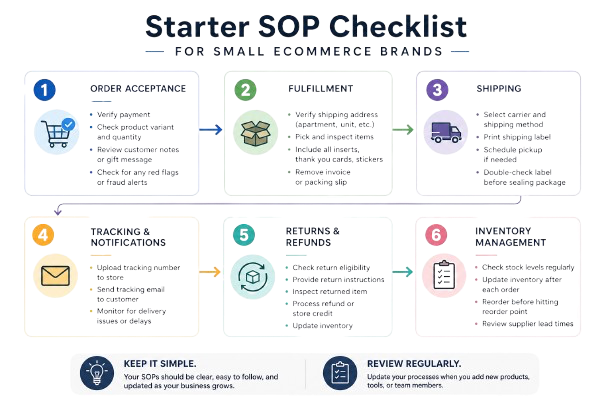
Starter SOP Checklist for Small Ecommerce Brands
- Order Acceptance: Verify payment, product variant and special instructions. Note out of stock alerts.
- Fulfillment: Check address, assemble products, package following a standard layout, remove receipts and attach the correct label.
- Shipping: Choose a carrier, print labels, schedule pickups and email tracking to customers.
- Returns: Define acceptable return window, inspection steps, refund approval and restocking procedure.
- Customer Support: Maintain response templates for common questions such as shipping times, product care, and returns. Personalise when needed.
- Inventory Management: Track stock levels, set reorder thresholds and record supplier contact information.
Conclusion
Documenting your processes might feel tedious at first, but it’s a crucial part of running a professional ecommerce brand. It isn’t about making your business feel corporate; it’s about making your work repeatable, teachable and less fragile. When you capture your knowledge in simple, clear documents, you reduce mistakes, protect customer trust and give yourself room to grow.
Your brand’s uniqueness lies in your products and your values. Not in the chaos behind the scenes. By documenting your workflows now, you’re investing in a smoother future.